Networking tipsOct 24, 202613 min read
How to Network: A Practical Guide to Meeting the Right People Professionally
How to network without feeling fake: a step-by-step guide to knowing who you need, reaching out, following up and building relationships that last.
In this article13
- Why most networking feels awkward (and how to fix that)
- Step 1: Decide who you need to meet, and why
- Step 2: Make your own profile do half the work
- Step 3: Find the right people in the right places
- Step 4: Write a first message people want to answer
- Step 5: Give before you ask
- Step 6: Have a good first conversation
- Step 7: Follow up, and keep the relationship warm
- How to network if you're an introvert, new, or far from the big cities
- Common networking mistakes to avoid
- A 30-minute weekly networking routine
- Frequently asked questions
- Conclusion
Networking is simply meeting people who can help you, and whom you can help, in your work. Done well, it doesn't feel like selling. It feels like asking a good question to the right person at the right time, and then staying in touch.
If you want the short version of how to network: decide exactly who you need to meet and why, make it easy for them to say yes, offer something before you ask for anything, follow up within a few days, and keep the relationship warm with small, regular check-ins. Everything else in this guide is detail on how to do each of those steps well.
The rest of this article walks through it in order — from defining your goal to writing the first message, handling silence, and turning a single conversation into a relationship. There are templates you can copy, a weekly routine you can actually keep, and an honest look at which places work best for which kind of networking.
Why most networking feels awkward (and how to fix that)
Most people don't hate networking. They hate bad networking: the room full of strangers swapping business cards, the cold message that opens with a pitch, the follow-up that never comes. Those experiences share three problems.
- No clear goal. "Expanding my network" isn't a goal. Without one, you don't know who to talk to or what to say.
- Asking too soon. A stranger asking for a job, an investment or a referral in the first message is asking for trust they haven't earned.
- Too much noise. On platforms built around feeds, your message competes with hundreds of posts and a crowded inbox.
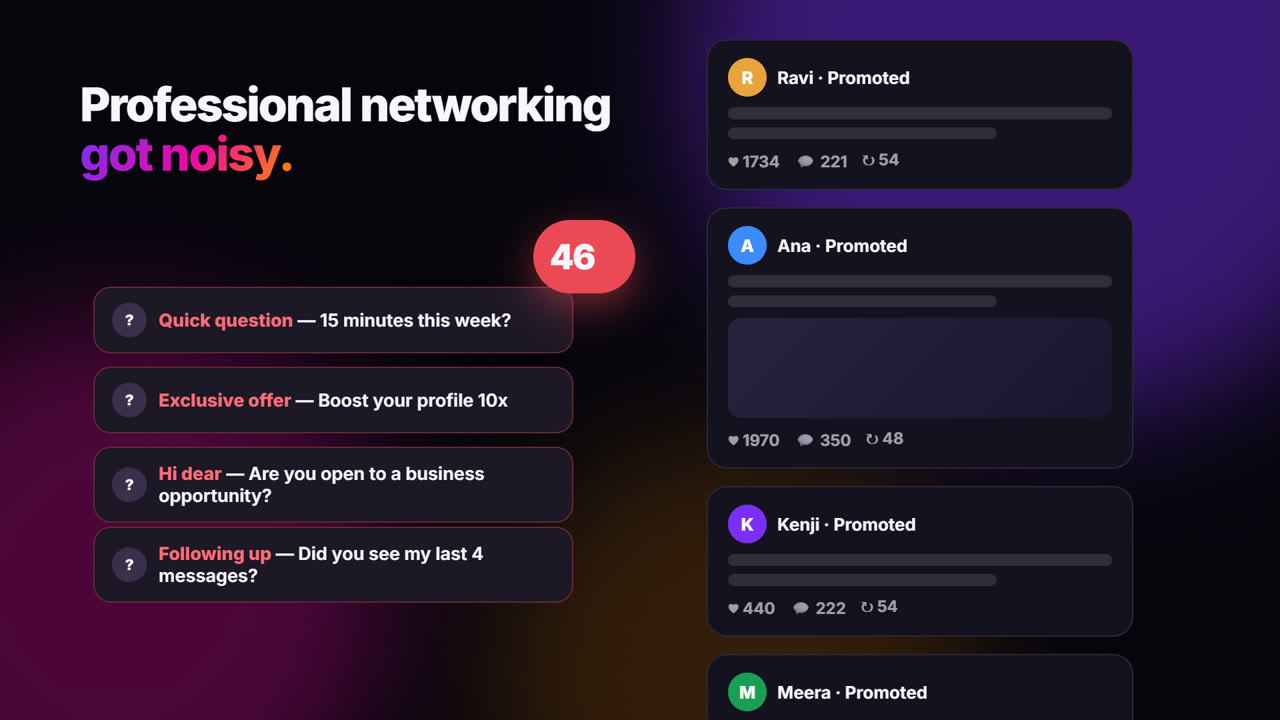
Fix those three things and networking becomes much less uncomfortable. You know who you're looking for, you give before you take, and you reach people in places where your message can actually be read.
Step 1: Decide who you need to meet, and why
Before you talk to anyone, write one sentence that finishes this: "In the next three months, I want to meet ___ so that ___."
Some examples:
- "…a technical co-founder with backend experience, so I can build the first version of my product."
- "…two or three product managers at fintech companies, so I can understand what the role really involves before I apply."
- "…a mentor who has run a services business, so I stop underpricing my work."
- "…five potential clients in the hospitality industry, so I can test whether my booking tool solves a real problem."
This sentence does a lot of work. It tells you which industries, roles, cities and seniority levels to search for. It gives you a reason to reach out that the other person can understand in one line. And it stops you from collecting contacts who will never matter to either of you.
Make a short target list
Turn the sentence into a list of 10–20 people or profiles. For each, note:
| What to note | Why it matters |
|---|---|
| Name and role | So you can personalise your message |
| How you found them | Gives you a natural opening line |
| One specific thing about their work | Shows you've done your homework |
| What you could offer them | Keeps the relationship two-way |
| Status (not contacted / sent / replied / met) | So nobody falls through the cracks |
A simple spreadsheet or notes app is enough. The point is to network on purpose, not by accident.
Step 2: Make your own profile do half the work
When someone gets your message, the first thing they do is look at who you are. Your profile — on any platform — should answer three questions in a few seconds: who are you, what do you do, and what are you looking for right now?
- Headline: be specific. "Backend engineer building payment tools for small shops" beats "Passionate technologist".
- About: three or four short sentences. What you've done, what you're doing, what you'd like to do next.
- Proof: experience, education, skills and a link or two (a portfolio, a GitHub, a website).
- Your current goal: say it plainly. People can't help you with something they don't know about.
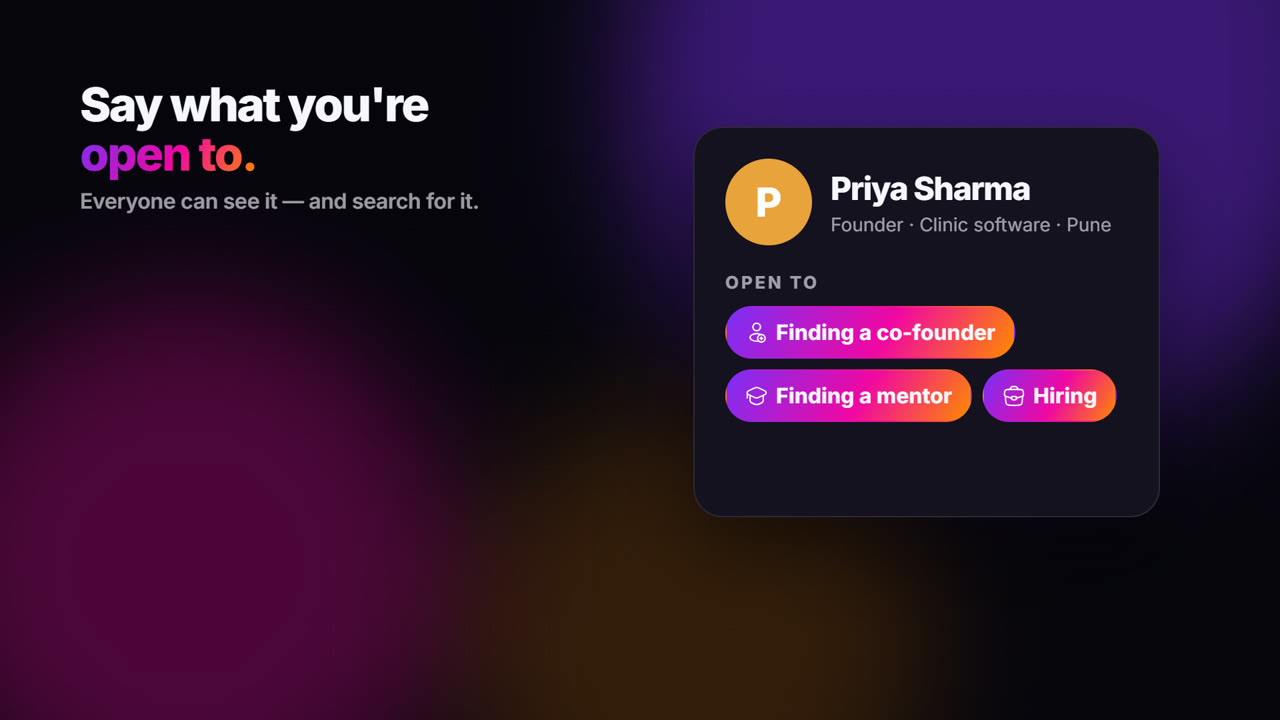
On Networthers, that last point is built in. Every profile has an "Open to" section — mentoring others, finding a mentor, finding a co-founder, hiring, a new role, investing, raising funds, new clients, partnerships or collaborating — and other members can filter search by it. That means the people you want to meet can find you too, not just the other way round.
Step 3: Find the right people in the right places
Where you network matters as much as how. Different places are good at different things, and the honest answer is that most people use a mix.
| Where | Good for | Watch out for |
|---|---|---|
| Industry events and meetups | Warm, in-person first impressions; meeting several people at once | Time and travel; conversations that are hard to follow up |
| Alumni groups and communities | Instant common ground | Can be broad; hard to find someone specific |
| Group chats (WhatsApp, Slack, Discord) | Fast, informal conversation within a community | Messages get buried; not built for finding individuals |
| Large professional networks like LinkedIn | Enormous reach, job listings, recruiters, publishing your work | A busy feed and a crowded inbox; paid messaging to strangers |
| Networthers | Finding a specific kind of person by what they're open to, and talking without noise | A newer, smaller network than the big platforms |
If you want a deeper look, we've compared these in detail in networking events vs cold email vs Networthers and in Networthers vs LinkedIn.
Searching with intent
Whatever platform you use, search for the situation you want, not just a job title. On Networthers, Discover lets you search by name, role, company or skill and filter by country, industry and what people are open to. A search like "product designer" filtered to your country and "open to: co-founder" gives you a short list of people — this is how finding a co-founder on Networthers works — who have already said they're interested in exactly the conversation you want to have.
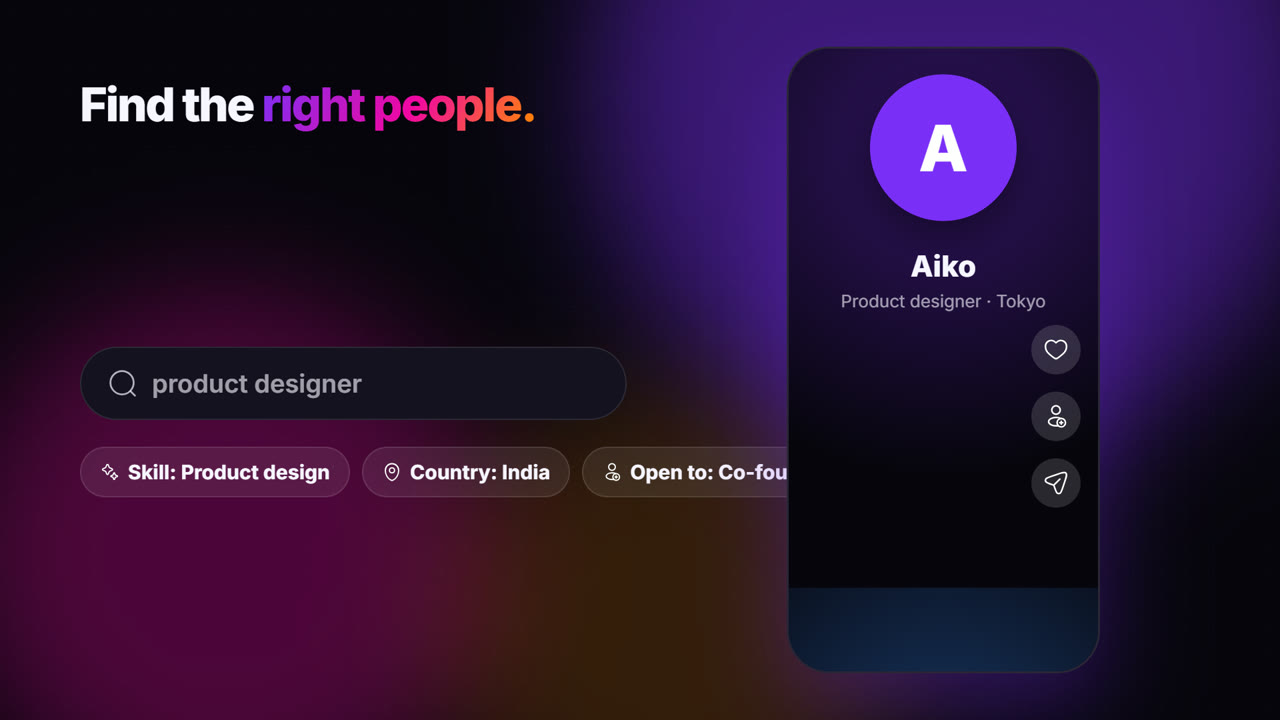
If you'd rather browse, Swipe shows profiles one at a time, full screen. It's a relaxed way to explore an industry or a city when you don't yet know exactly who you're looking for.
Step 4: Write a first message people want to answer
The first message is where most networking succeeds or fails. A good one is short, specific and easy to say yes to. It has four parts:
- Context: how you found them, or what you have in common.
- Something specific: one detail about their work that shows you actually looked.
- A small, clear ask: a question, a 15-minute call, or simply connecting.
- An easy out: make it fine for them to say no or "not now".
Keep it under 300 characters where you can. On Networthers, the optional note on a connection request is capped at 300 characters, which turns out to be a useful discipline.
Templates you can copy
Finding a co-founder:
Hi Arjun — saw you're open to co-founding and have built two B2B tools. I'm working on inventory software for small pharmacies and need a backend partner. Would you be up for a 20-minute call next week? No pressure if the timing's wrong.
Finding a mentor (more on this in our find a mentor page):
Hi Meera — your move from consulting to running your own design studio is exactly the path I'm trying to take. Could I ask you two or three questions over a short call? Happy to work around your schedule.
Exploring a role:
Hi Daniel — I'm a data analyst thinking about moving into product. You made that switch at a fintech company. Would you share what you wish you'd known before? Even a few lines by message would help a lot.
Reaching a potential client:
Hi Fatima — I build booking tools for boutique hotels and noticed you run three properties in Goa. I'm not selling anything yet; I'd love 15 minutes to understand how you handle bookings today.
Reconnecting with someone you met:
Hi Kenji — great talking at the product meetup on Thursday about onboarding flows. Here's the article on activation metrics I mentioned. Let's keep in touch.
Notice what these don't do: they don't attach a CV, pitch a product, or ask for a job or an introduction in the first line.
Step 5: Give before you ask
The fastest way to stop networking from feeling transactional is to lead with value. That doesn't mean you need to be senior or well connected. Useful things anyone can offer:
- A relevant article, tool or resource, with one line on why you thought of them.
- Honest feedback on their product, website or talk, if they've asked for it.
- An introduction to someone in your own network who could help them.
- Sharing what you've learned in your own field, especially if it's adjacent to theirs.
- Simple recognition: telling them specifically what you found useful in their work.
On Networthers, a like on a profile is a light way to say "your work caught my eye" — the person sees it in their Activity, and it doesn't ask anything of them. It's a softer signal than a request, and it's a reasonable first step when you're not ready to ask for a conversation yet.
Step 6: Have a good first conversation
When someone says yes, respect their time and come prepared.
Before the call
- Re-read their profile and anything they've shared.
- Write down three questions you genuinely want answered.
- Know what a good outcome looks like: advice, a decision, a next step, or just a new relationship.
During the call
- Start on time and confirm how long they have.
- Ask, then listen. Aim for them to talk more than you.
- Ask follow-up questions: "What made you decide that?" "What would you do differently?"
- Near the end, ask: "Is there anyone else you think I should talk to?"
- Finish on time, even if it's going well.
Questions that work well
- "What does a typical week look like in your role?"
- "What's the hardest part of what you do that people don't see?"
- "If you were in my position, what would you do first?"
- "What's something you've changed your mind about recently?"
Step 7: Follow up, and keep the relationship warm
Most networking value is lost after the first conversation. A follow-up within 48 hours fixes that. Thank them, mention one specific thing you'll act on, and if you promised something — an article, an introduction — send it.
Thanks for the time today, Meera. Your point about pricing by project rather than by hour really stuck — I'm rewriting my proposal template this week. I'll let you know how the first one goes.
Then close the loop later. Two or three weeks on, tell them what happened when you took their advice. People remember those who report back, because so few do.
A light rhythm that works
| When | What to do |
|---|---|
| Within 48 hours | Thank-you message with one specific takeaway |
| 2–4 weeks | Update on what you did with their advice |
| Every 2–3 months | Share something useful, or congratulate them on news |
| When you need help | Ask clearly — the relationship is already there |
Keeping these conversations in one place helps. On Networthers, only your connections can message you, so your inbox holds the people you actually chose to talk to. Messages can carry text, photos, voice messages, documents and more, which makes it easy to send the slide deck or portfolio you mentioned on the call.
How to network if you're an introvert, new, or far from the big cities
You don't need to be outgoing, senior or based in a major hub to network well.
If you're an introvert: favour one-to-one conversations over crowded rooms, and written first contact over cold calls. Prepare your questions in advance. Set a small, specific goal — two messages a week is plenty — and stop when you've hit it.
If you're a student or early in your career: your curiosity is your strongest asset. People are generous with advice when the ask is small and sincere. Ask about decisions and paths, not for jobs.
If you're outside the big cities: online networking removes most of the geography problem. Search by industry and what people are open to rather than by city, and use video calls freely.
If you're networking across languages: don't let language stop a good connection. Networthers works in 20 languages, including Hindi, Bengali, Marathi, Tamil, Telugu and Urdu, and profiles and messages can be translated with a tap.
Common networking mistakes to avoid
- Mass messages. If it could be sent to anyone, it will be ignored by everyone.
- Pitching in the first line. Earn the conversation before you sell anything.
- Asking for too much. "Can you refer me?" to a stranger is a big ask. "What's the team like?" is a small one.
- Only networking when you need something. The best time to build relationships is before you need them.
- Forgetting to follow up. One thank-you message puts you ahead of most people.
- Taking silence personally. People are busy. One polite nudge after a week is fine; after that, move on.
- Collecting contacts instead of relationships. Ten people who know you well are worth more than a thousand who don't.
A 30-minute weekly networking routine
Networking works best as a small habit rather than an occasional burst. Here's a routine that fits into half an hour:
- 10 minutes — find: add three or four new people to your target list.
- 10 minutes — reach out: send two personalised messages or connection requests.
- 5 minutes — follow up: reply to anyone who answered, and send any thank-yous you owe.
- 5 minutes — give: share one useful thing with someone already in your network.
Do this for three months and you'll have had a dozen or more real conversations with people relevant to your goal — which is far more useful than hundreds of passive connections.
Frequently asked questions
How do I start networking with no connections at all? Start with a clear goal and a short target list, then reach out to people who have said they're open to the kind of conversation you want — mentoring, hiring, collaborating. Small, specific asks get replies even when you have no shared contacts.
How many people should I reach out to each week? Two to five thoughtful, personalised messages a week is plenty for most people. Quality beats volume: a short, specific note to the right person does more than twenty generic ones.
What should I write in a connection request? Say how you found them, mention one specific thing about their work, and make one small ask. Keep it under 300 characters, and make it easy for them to say "not now".
Is online networking as good as meeting in person? They work well together. Online is better for finding the right specific person and making first contact; meeting in person, or on a video call, is better for building trust quickly. Many strong professional relationships start online and deepen offline.
What if someone doesn't reply? Send one polite follow-up after about a week. If there's still no reply, move on without taking it personally — and keep the door open, because timing often changes.
Conclusion
Learning how to network is less about confidence and more about method: know who you need to meet and why, make your own goals visible, write short and specific messages, give before you ask, and follow up. Do that consistently, a little each week, and the right people stop being strangers. If you want a place built for exactly this — no feed, two-yes connections, and search by what people are open to — create a free Networthers account and send your first thoughtful message today.
Found this useful? Like it or pass it on.
Meet the people worth knowing
Networthers is professional networking with no feed and no cold messages. Free to join.
Join now