MentorshipOct 24, 202613 min read
How to Find a Mentor: A Step-by-Step Guide That Actually Works
How to find a mentor who can really help: decide what you need, find the right people, write a first message they'll answer, and keep the relationship going.
In this article12
- What a mentor is (and what a mentor isn't)
- Step 1: Decide exactly what you need help with
- Step 2: Start with the people you already know
- Step 3: Look where experienced people are open to helping
- Step 4: Write a first message that's easy to say yes to
- Step 5: Make the first conversation worth their time
- Step 6: Follow up, and turn one conversation into a mentorship
- Mistakes that quietly end mentoring relationships
- Finding a mentor in another city or country
- How to become someone people want to mentor
- Frequently asked questions
- Conclusion
The fastest way to find a mentor is to stop looking for "a mentor" and start looking for help with one specific problem. Decide what you're stuck on, find two or three people who have solved that exact problem recently, and ask each of them one small, clear question. The mentoring relationships that last almost always start this way — with a useful conversation, not a formal request.
So the short answer to how to find a mentor is: get specific about what you need, look where experienced people are open to helping, write a short message that's easy to answer, make the first conversation worth their time, and follow up with what you did with their advice. That last step is the one most people skip, and it's the one that turns a single call into a mentor.
This guide walks through each step in order, with message templates you can copy, the questions to ask in a first meeting, and the mistakes that quietly end most mentoring relationships before they begin.
What a mentor is (and what a mentor isn't)
A mentor is someone further along a path you're on who shares what they've learned, so you can make better decisions faster. That's it. They don't have to be famous, senior to everyone, or in your company. Often the most useful mentor is only three to five years ahead of you, because they remember your stage clearly.
It helps to know what a mentor is not, because confusing these is the reason many requests go unanswered:
- Not a sponsor. A sponsor uses their influence to get you a role or a deal. That comes later, if at all, and only after trust.
- Not a coach or a consultant. Those are paid, structured services. A mentor gives occasional advice out of goodwill.
- Not a single person for everything. Most people who grow quickly have several mentors at once — one for their craft, one for their career, one for the business side.
Step 1: Decide exactly what you need help with
Write down the problem in one sentence. "I want to grow in my career" is too vague for anyone to help with. Compare these:
- "I'm a QA engineer and want to move into product management within a year, and I don't know which skills to build first."
- "I run a two-person design studio and keep underpricing projects."
- "I'm building a B2B software product and need to learn how to sell to my first ten customers."
- "I'm a final-year student deciding between a job offer and a master's degree abroad."
A sentence like this does three things. It tells you who to look for (someone who has made that move, run that business, made that decision). It gives the other person a reason to say yes, because they can see in seconds whether they can help. And it keeps the first conversation focused.
Pick the type of mentor you need
Different problems call for different people. A rough guide:
| Your situation | The mentor who helps most |
|---|---|
| Learning a craft (design, engineering, sales) | A practitioner a few years ahead of you in the same craft |
| Changing roles or industries | Someone who made the same switch recently |
| Starting or growing a business | A founder who has been through your current stage |
| Leading a team for the first time | A manager who remembers their first year as a manager |
| Big personal-career decisions | Someone senior with broad experience and no stake in your choice |
You can have more than one. Start with the one tied to your most urgent problem.
Step 2: Start with the people you already know
Before searching for strangers, look at your existing circle. Mentors are often hiding in plain sight: a former manager, a senior colleague in another team, a professor, a client you worked well with, an alumnus of your college, a friend's older sibling who works in your field.
People who already know you have two advantages. They trust you a little already, and they understand your context, so their advice is more specific. Make a list of five such people and ask yourself: who among them has solved the problem I wrote down in Step 1?
If nobody on the list fits, that's normal. It simply means you need to widen the search.
Step 3: Look where experienced people are open to helping
The hardest part of finding a mentor online is that you can't tell who is willing to help. Most senior people get far more requests than they can answer, and on busy platforms your message lands in an inbox next to sales pitches and recruiter spam.
The better places to look have one thing in common: they make it clear who is open to mentoring.
- Alumni networks — college and company alumni groups are full of people who feel some loyalty to people from the same place.
- Professional associations and communities — industry bodies, local chapters, and meetups where people come to share what they know.
- Startup programmes — incubators, accelerators and founder communities often have mentors attached to them.
- Events and talks — the speaker who shared something useful is a natural person to follow up with afterwards.
- Networking platforms with clear intent — places where people say up front what they're open to.
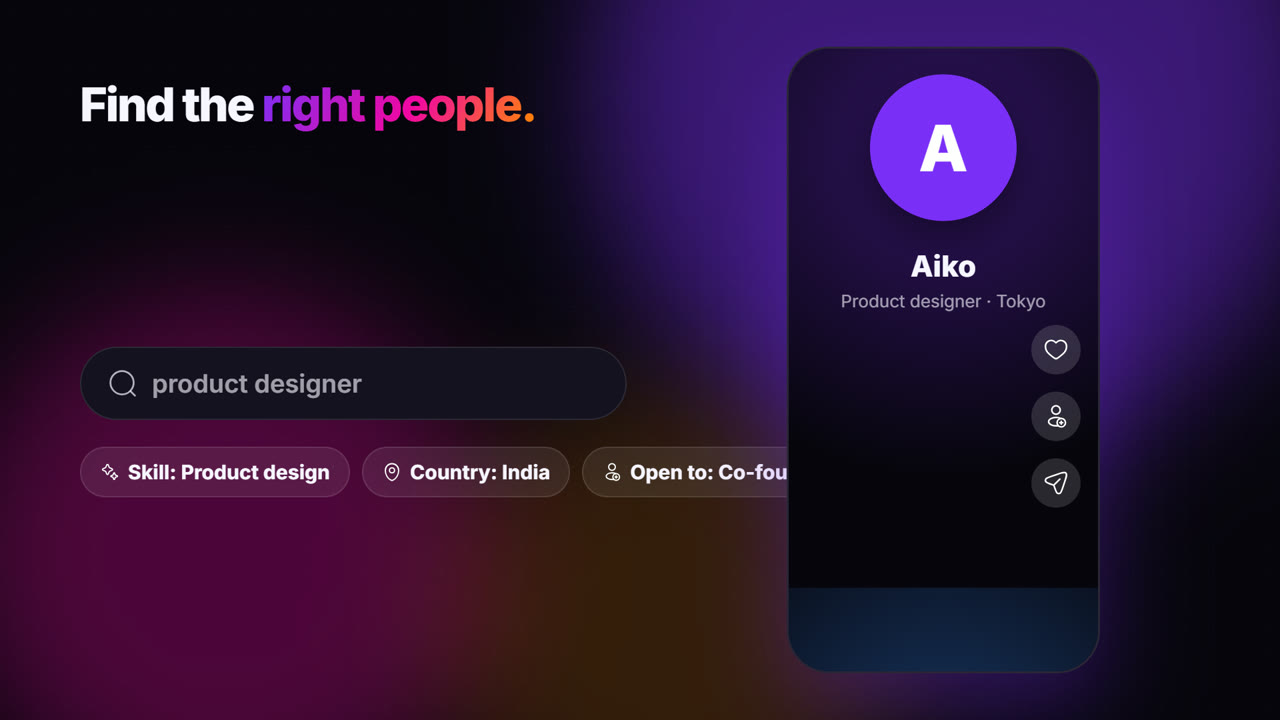
This is where Networthers fits naturally. Every profile has an "Open to" section, and mentoring others and finding a mentor are two of the options. In Discover, you can search by role, company or skill and filter by country, industry and what people are open to — so you can look for, say, product managers in fintech who are open to mentoring others, instead of guessing who might reply. If you prefer browsing, Swipe shows profiles one at a time, full screen. There's a dedicated page for this too: find a mentor on Networthers.
Whatever platform you use, set your own profile to say you're looking for a mentor. On Networthers that's the finding a mentor option in "Open to". It quietly tells people why you're reaching out before you've said a word.
Make your profile mentor-ready
Before you message anyone, spend twenty minutes on your profile. A potential mentor will look at it first. It should answer, in seconds:
- Who you are: a clear headline ("Junior data analyst at a logistics company, moving into product").
- What you've done: experience, education, skills, and one or two links to real work.
- What you're looking for: stated plainly, ideally the sentence from Step 1.
A thin or vague profile makes even a good message feel risky to answer.
Step 4: Write a first message that's easy to say yes to
Your first message has one job: to get a short, useful reply. Not a commitment, not a weekly call — just a reply. Keep it under 300 characters if you can. (Networthers limits connection notes to 300 characters, which is a useful discipline anywhere.)
A good first message has four parts:
- Why them — one specific reason you chose this person.
- Your situation — one line, from Step 1.
- One small ask — a single question, or 15 minutes.
- An easy out — so saying no costs them nothing.
Templates you can copy
For someone who made a move you want to make:
Hi Anjali — I saw you moved from QA into product at a fintech company. I'm trying to make the same switch. Could I ask you one question about which skills mattered most? Totally fine if you're busy.
For a founder a stage ahead of you:
Hi Rohan — I'm building scheduling software for clinics and you've sold to hospitals before. I'm stuck on getting the first ten customers. Would you be open to a 15-minute call sometime this month?
For someone you heard speak:
Hi Meera — your talk on pricing design work changed how I quote projects. I tried your "three options" idea last week and it worked. Could I ask one follow-up question about retainers?
For an alumnus:
Hi Arjun — fellow alumnus of your college here, now a second-year analyst. You've built a career in consulting, which I'm considering. Could I ask you two quick questions over chat?
Notice what none of these say: "Will you be my mentor?" That question asks for an open-ended commitment from a stranger. Most people say no, or don't reply, not because they don't want to help but because they can't promise the time.
On Networthers, a connection takes two yeses: you send a request with your note, and nobody joins your network without accepting. Only connections can message each other, so once someone accepts, you know they've agreed to hear from you. That makes a reply far more likely than a cold message dropped into a stranger's inbox.
What to do if nobody replies
Silence is normal. Busy people miss messages. A good rhythm:
- Send to three to five people at once, not one at a time.
- Wait a week. Then send one short, friendly follow-up that adds something new ("Since I wrote, I've narrowed it down to two options…").
- If there's still no reply, move on without resentment. It wasn't personal.
Step 5: Make the first conversation worth their time
When someone says yes, prepare properly. Twenty minutes of preparation makes the difference between a pleasant chat and a mentor.
Before the call:
- Read their profile and anything they've written or spoken about.
- Write three questions, ranked. You may only get to the first two.
- Prepare a 30-second summary of your situation so you don't spend ten minutes on background.
Good questions to ask:
- "If you were in my position today, what would you do first?"
- "What did you get wrong at my stage that I could avoid?"
- "Which skill made the biggest difference for you, and how did you build it?"
- "Who else should I talk to about this?"
That last question is gold. Mentors who can't help with everything often know someone who can, and a warm introduction is worth ten cold messages.
During the call: keep to time, take notes, and listen more than you talk. If the 15 minutes are up, say so and offer to stop — they'll often choose to keep going.
Right after: send a short thank-you within 24 hours that names one specific thing you'll do with their advice.
Step 6: Follow up, and turn one conversation into a mentorship
This is the step that separates people who have mentors from people who once had a nice call. Two to four weeks after the conversation, send an update:
Hi Anjali — thanks again for your advice in September. I took your suggestion and built a small product spec for a feature at work; my manager liked it and I'm now helping on the roadmap. One new question, if you have a minute: how did you handle your first product review?
This message does something powerful. It shows the mentor their time made a difference — which is the main reward mentors get. And it opens the door to the next question naturally. After two or three exchanges like this, you have a mentor, whether or not either of you ever uses the word.
Keep it light and regular
- Update every month or two, even when you don't need anything.
- Ask one question at a time. Long lists feel like homework.
- Respect their channel. If they prefer chat to calls, use chat. Voice notes can be easier than scheduling a call — on Networthers, messages can carry voice messages, documents and links, so a quick question doesn't need a meeting.
- Offer something back. You might share an article they'd find useful, give feedback on their product, or introduce them to someone. Mentoring is never fully two-way, but it shouldn't be one-way either.
Mistakes that quietly end mentoring relationships
Most mentorships don't end with an argument. They fade. Here are the usual causes:
- Asking for too much, too soon. A job referral or an investment in the first conversation turns advice into a transaction.
- Ignoring the advice. If you ask, receive thoughtful advice, and then do the opposite without explanation, people stop investing time.
- Only getting in touch when you need something. Updates with no ask keep the relationship warm.
- Making them chase details. Send agendas, documents and context ahead of time.
- Choosing a mentor for their title, not their experience. A famous name who has never faced your problem is less useful than someone who solved it last year.
- Having only one mentor. One person can't cover every area. Build a small group of three or four people you can ask about different things.
Finding a mentor in another city or country
Your best mentor may not live near you. Someone who built a business in another country, or worked in a market you want to enter, can give you a perspective nobody local can.
Language can be a barrier here, but it doesn't have to be. Networthers is available in 20 languages — including Hindi, Bengali, Marathi, Tamil and Telugu as well as English, Spanish, Arabic, Japanese and more — and profiles and messages can be translated with a tap. That opens up mentors you might never have found if you only searched in one language.
A few tips for long-distance mentoring:
- Mention time zones when you suggest a call, and offer two or three options in their time.
- Prefer short written questions or voice notes over long calls.
- Be explicit about context — their market may work very differently from yours.
How to become someone people want to mentor
Finally, it helps to understand what makes mentors want to keep helping. In practice, people enjoy mentoring someone who is:
- Curious — asks thoughtful questions, not ones answered by a quick search.
- Prepared — respects their time.
- Action-oriented — does something with the advice.
- Honest — says what went wrong, not just what went right.
- Grateful — remembers to say thank you and share results.
None of these depend on your seniority, college or city. A student who follows through is a far more rewarding mentee than a senior professional who doesn't.
And once you've been helped, pass it on. Mark yourself as open to mentoring others and answer the occasional question from someone a few years behind you. You'll be surprised how much it sharpens your own thinking. If you're new to building professional relationships in general, our guide on how to network covers the wider basics.
Frequently asked questions
How do I ask someone to be my mentor? In most cases, don't ask directly. Ask for advice on one specific problem, make the conversation useful, follow up with what you did, and keep in touch. The relationship becomes a mentorship naturally. If a formal arrangement suits you both later, you can propose it then.
Can I find a mentor online for free? Yes. Most mentoring is informal and unpaid — advice given out of goodwill. Alumni networks, professional communities and networking platforms all let you reach experienced people for free. Networthers is free to join, and you can filter for people who are open to mentoring others.
How many mentors should I have? Usually two to four, each for a different area — your craft, your career path, and perhaps the business or leadership side. One mentor for everything puts too much weight on a single relationship.
How often should I talk to my mentor? There's no fixed rule. A short update every month or two, plus a question when something important comes up, works for most people. Let the mentor's preferences set the pace.
What if my mentor stops replying? People get busy. Send one friendly update with no ask after a few weeks. If there's still nothing, let it rest without taking it personally, and lean on the other people in your group.
Conclusion
Finding a mentor isn't about finding one perfect person who agrees to guide your whole career. It's about asking good questions to the right people, making their help worthwhile, and staying in touch long enough for trust to grow. Start with a clear problem, look where experienced people say they're open to helping, write a short message that's easy to answer, and always follow up with what you did. Do that with three or four people, and within a few months you'll have the kind of support most people only wish for.
If you want a calm place to start, without a feed or a crowded inbox, create a free Networthers account, set "Open to" to finding a mentor, and search for people who are open to mentoring others in your field.
Found this useful? Like it or pass it on.
Meet the people worth knowing
Networthers is professional networking with no feed and no cold messages. Free to join.
Join now