FoundersOct 24, 202614 min read
How to Find a Co-Founder: A Practical Guide for First-Time Founders
How to find a co-founder you can build with: know the role you need, where to look, what to say first, how to test the fit, and what to agree before you start.
In this article11
- Do you actually need a co-founder?
- Step 1: Define the role you need — and what you bring
- Step 2: Where to look for a co-founder
- Step 3: Write a first message that gets a reply
- Step 4: Have the right first conversations
- Step 5: Test the fit with a trial project
- Step 6: Agree the hard things in writing
- Finding a co-founder with Networthers
- Common mistakes to avoid
- Frequently asked questions
- Conclusion
The most reliable way to find a co-founder is to stop searching for "a co-founder" in general and start working with specific people on something small. Decide what role is missing, go where people with that skill are actively open to starting something, have a handful of honest conversations, and then build a short trial project together before anyone signs anything. Most strong founding teams are formed this way: by working together first and deciding second.
So the short answer to how to find a co-founder is: know what you need and what you bring, widen your circle on purpose, write a first message that is specific and easy to answer, test the partnership with real work, and put the important things in writing early — equity, roles, time commitment and what happens if someone leaves.
This guide walks through each step, with message templates, a list of questions to ask before you commit, a simple trial-project plan, and the warning signs that tell you to walk away while it's still cheap to do so.
Do you actually need a co-founder?
Before you look, be honest about why. A co-founder is not a hire, an advisor or a freelancer. It's someone who will own a large part of the company, share the hard decisions and stay through the years when nothing works. That is a big thing to give and to ask for.
You probably do need one if:
- A core skill is missing and you can't learn it fast enough. A non-technical founder building a software product, or an engineer building something that lives or dies on sales.
- The workload is more than one person can carry for the first two years, and you can't pay people yet.
- You know you work better with a partner — someone to argue with, share the lows and keep you honest.
You may not need one (yet) if the missing piece is narrow and well defined. A logo, a landing page or a first prototype can come from a freelancer. Advice on fundraising can come from a mentor. Giving away a third of your company to solve a three-month problem is one of the most common and expensive early mistakes.
Step 1: Define the role you need — and what you bring
Write two short lists before you talk to anyone.
What I bring. Your skills, your network, your knowledge of the customer, the time you can give, the money you can put in, and any traction so far (users, a waitlist, letters of intent, a working prototype). Be concrete. "Passion" is not on this list; "five years selling to hospital procurement teams" is.
What's missing. The skills and responsibilities the other person would own. Phrase it as outcomes, not titles: "build and ship the first version of the app and own the technology decisions" says far more than "CTO".
The common pairings
| If you are mainly… | You often need someone who… |
|---|---|
| A builder (engineer, designer) | Sells, raises money, talks to customers every day |
| A seller or domain expert | Builds the product and owns technical decisions |
| An operator (logistics, finance) | Brings product vision or deep technical skill |
| A researcher or scientist | Turns research into a product people will pay for |
Complementary skills matter, but shared values and similar ambition matter more. Two people with perfect skill overlap and different ideas about how big the company should get, how hard to work or how to treat people will not last.
Decide the non-negotiables
Write down three to five things you won't compromise on. For example: full-time within three months, based in the same city or comfortable working remotely, willing to work without salary for a year, comfortable raising outside investment (or not). These save you weeks of conversations that were never going to work.
Step 2: Where to look for a co-founder
Most founders meet co-founders through people they already know: former colleagues, classmates, friends of friends. That's because trust is already partly built. Start there, then widen the circle on purpose.
Your existing network
Go through your old teams, your college batch, past clients and people you've worked with on side projects. Ask yourself: who did I trust under pressure? Who did I actually enjoy solving problems with? A message to a former colleague saying "I'm working on X, here's why, who do you know who'd be great at Y?" often works better than any platform, because the reply comes with a personal introduction.
Communities where builders gather
- Hackathons and build weekends. You see how someone works under time pressure, which tells you more than any interview.
- Startup events, meetups and incubator programmes. Good for meeting people already thinking about starting something. Our guide to networking events vs cold email covers how to make events worth your time.
- Online communities in your domain — open-source projects, design communities, industry forums and group chats. Contribute first; ask later.
- University entrepreneurship cells and alumni groups, especially useful for student and first-time founders in India.
Platforms where people say they're open to it
The hardest part of finding a co-founder is that you can't tell who is actually looking. Most people's profiles say what they do, not what they want next. That's why it helps to search where people state it outright.
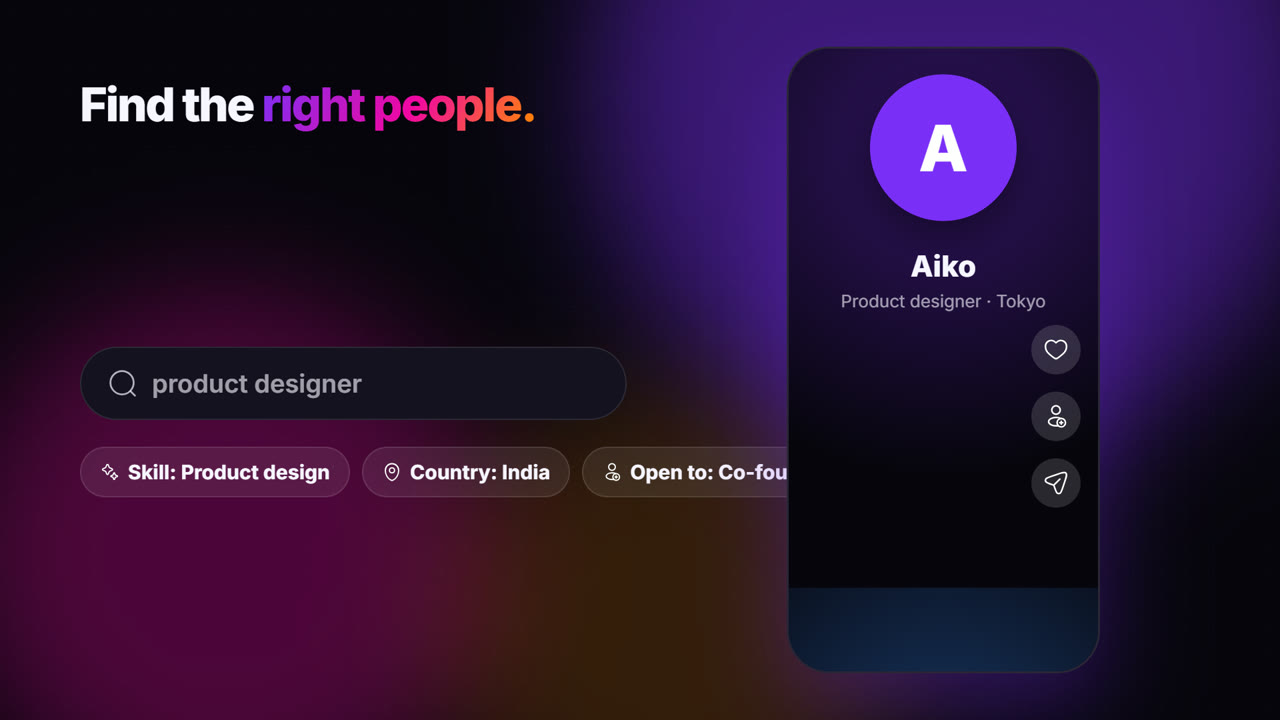
On Networthers, every profile has an "Open to" section, and "finding a co-founder" is one of the options, alongside mentoring, hiring, investing and partnerships. In Discover you can search by role or skill — "backend engineer", "growth marketer", "product designer" — and filter by country, industry and who is open to finding a co-founder. The find a co-founder page explains how it works.
Other platforms help too. LinkedIn is far larger and shows detailed work histories, which is useful for checking someone's background. Dedicated co-founder matching programmes exist as well, often run by accelerators. Use whichever gets you in front of the right people — the method in the rest of this guide works on any of them.
Step 3: Write a first message that gets a reply
People who are open to starting something still get plenty of vague messages. Yours should make it easy to say yes to one short conversation — not to the whole company.
A good first message has four parts:
- Why them, specifically — something from their profile or work.
- What you're building, in one line — the problem and who has it.
- What you bring — proof you're serious.
- A small ask — a 20-minute call, not "do you want to be my co-founder?"
Templates you can adapt
To a potential technical co-founder (connection note, under 300 characters):
Hi Arjun — saw you built the payments system at your last company. I'm building billing software for small clinics; 12 have tried the prototype. Looking for a technical partner. Open to a 20-min call this week?
To a potential business co-founder:
Hi Meera — your work growing a B2B product in pharma caught my eye. I'm an engineer with a working tool for pharmacy inventory and need someone who knows how this market buys. Would you be up for a short chat about it?
To a former colleague:
Hey Sam, it's been a while! I've left my job to build something for freelance accountants and I keep thinking about how well we worked on the reporting project. No pressure at all — could I tell you about it over a call?
Notice what these don't do: no long pitch deck, no equity numbers, no pressure. The first message has one job — getting the first conversation.
On Networthers, a connection request can carry an optional note of up to 300 characters, and nobody joins your network without accepting. Only connections can message each other, so the person you're writing to hasn't been buried in cold pitches from strangers — and your note gets read.
Step 4: Have the right first conversations
The first call isn't an interview and it isn't a pitch. It's two people checking whether a longer conversation is worth having. Spend half of it listening.
Questions to ask in the first call
- What are you working on now, and what would make you leave it?
- What kind of company do you want to build — a large venture-backed company, a profitable small business, something in between?
- How much time could you realistically give in the next three months?
- What's your financial runway? How long can you go without a salary?
- What did you learn from the last team you worked in — what worked and what didn't?
- What would you need to see to get excited about this?
What to listen for
Listen for curiosity about the problem rather than the title. Strong candidates ask hard questions about your customers and your numbers. Be wary of people who only want to talk about equity, fundraising and the exit before they understand the problem.
Plan to have many of these conversations. Ten to twenty first calls before finding the right person is normal, and each one sharpens how you explain the idea.
Step 5: Test the fit with a trial project
This is the step that separates teams that last from teams that break up within a year. Before you agree on equity or titles, build something together for two to six weeks.
A simple trial plan
| Week | What you do together | What you're learning |
|---|---|---|
| 1 | Talk to 10 potential customers, split the calls | Do you see the problem the same way? |
| 2 | Agree a small, testable version of the product | Can you make decisions together? |
| 3–4 | Build and ship it, each owning a part | Do you deliver what you promise? |
| 5–6 | Put it in front of users, review results honestly | How do you handle bad news and disagreement? |
Keep it real but small: a landing page with a waitlist, a prototype tested with five users, a first paid pilot. The goal isn't the output. It's seeing how the other person works when it's late, things break and you disagree.
Signs it's working
- You both do what you said you'd do, on time, without reminders.
- Disagreements end in a decision, not a grudge.
- You trust their judgement in their area without checking their work.
- You're more excited about the problem at the end than at the start.
Warning signs
- Repeated missed commitments with good excuses.
- Unwillingness to talk about money, time or what happens if it fails.
- "I'll go full-time once we raise funding" with no plan to get there.
- You avoid raising problems because you're afraid of the reaction.
If you see the warning signs, end it kindly and early. Walking away after six weeks costs very little. Walking away after two years with a split cap table costs a lot.
Step 6: Agree the hard things in writing
Once you're both sure, talk through the topics most founding teams avoid — and write the answers down. A short founders' agreement drafted with a lawyer protects the friendship as much as the company.
Co-founder agreement checklist
- Equity split and the reasoning behind it (who contributes what, now and later).
- Vesting — commonly four years with a one-year cliff, so equity is earned over time and a founder who leaves early doesn't keep a large stake.
- Roles and decision rights — who decides on product, hiring, spending and fundraising, and how ties are broken.
- Time commitment — full-time from when, and what counts as full-time.
- Salaries — when founders start paying themselves and how much.
- Intellectual property — everything built for the company belongs to the company.
- Leaving — what happens to equity, roles and responsibilities if someone steps away.
- Outside work — whether side projects or consulting are allowed.
In India, founders typically formalise this in the shareholders' agreement when the company is incorporated, often as a private limited company. Rules differ by country, so get advice from a lawyer or a chartered accountant who works with startups rather than relying on a template alone.
Finding a co-founder with Networthers
If you'd like a place built for exactly this kind of search, here is how Networthers fits in.
- Say what you're open to. Mark "finding a co-founder" on your profile so the right people can find you, and add your skills, industry, city and links so they can see what you bring.
- Search with intent. In Discover, look for people by role, company or skill, and filter by country, industry and who is open to finding a co-founder.
- Browse one person at a time. Swipe shows full-screen profiles one after another, so you can quickly open the ones worth a closer look, like them or send a connection request.
- Start with a short note. Add up to 300 characters explaining why you're reaching out.
- Talk properly once connected. Messages can carry documents up to 50 MB (a pitch deck or prototype notes), voice messages and photos, visible only to the two of you.
- Work across languages. Networthers is available in 20 languages, and profiles and messages can be translated with a tap — useful if your ideal partner is in another region of India or another country.
There's no feed and no posts, so your time goes into finding people, not scrolling. It's free to create an account. Networthers is newer and smaller than LinkedIn, so it works best alongside your existing network and communities rather than instead of them; our honest comparison with LinkedIn covers where each is stronger.
Common mistakes to avoid
- Choosing a friend because they're available. Friendship is a great start, but check the skills and commitment the same way you would with a stranger.
- Choosing the first person who says yes. Excitement after one good call isn't a partnership. Do the trial project.
- Splitting equity on day one without vesting. It feels generous; it can cripple the company later.
- Looking only in your own city or industry. Remote founding teams are common now, and great partners often come from adjacent industries.
- Hiding the uncomfortable facts. Your debt, your family pressures, your doubts about the idea — your co-founder will find out eventually. Better now.
- Waiting for the perfect person. You're looking for someone you trust, who complements you and wants the same thing. Not a unicorn.
Frequently asked questions
How long does it take to find a co-founder? It varies a lot. Some founders find the right person in a few weeks through an old colleague; for others it takes several months of conversations and a couple of trial projects. Planning for ten to twenty first conversations is realistic.
Should a non-technical founder find a technical co-founder or hire developers? If technology is the core of the product and will need constant decisions, a technical co-founder is usually worth it. If you need a first version to test demand, a freelancer or agency can build it while you keep looking — and real traction makes it much easier to attract a strong technical partner.
How should co-founders split equity? There's no single right answer. Base it on what each person contributes now and over the coming years, discuss it openly, and always attach vesting (commonly four years with a one-year cliff). Get it into a written agreement with legal advice.
Can I find a co-founder online? Yes. Many founders meet through online communities and networking platforms, then build trust through calls and a trial project. On Networthers you can filter for people who are open to finding a co-founder, so you know they're actually looking.
What if my co-founder and I disagree on everything during the trial? Some disagreement is healthy; it means you're both thinking. The question is whether disagreements end in decisions you can both live with. If they keep ending in silence or resentment, part ways while it's still simple.
Conclusion
Finding a co-founder is less about luck and more about method: know what you need and what you bring, look where people are open to it, start with a small and specific message, test the partnership with real work, and write down the hard agreements before you build on them. Take your time with the trial — it's the cheapest insurance a startup can buy. If you'd like to search for people who have said they're open to finding a co-founder, create a free account on Networthers, fill in your profile and mark what you're open to. The right partner may be looking for you too.
Found this useful? Like it or pass it on.
Meet the people worth knowing
Networthers is professional networking with no feed and no cold messages. Free to join.
Join now