GuidesOct 25, 202615 min read
Elevator Pitch Examples for Networking: 15 Samples by Role, Plus a Simple Formula
15 elevator pitch examples for students, job-seekers, freelancers, founders, hiring managers and mentors, plus a fill-in formula you can adapt in minutes.
In this article13
- What makes an elevator pitch work
- The simple elevator pitch formula
- Elevator pitch examples for students and fresh graduates
- Elevator pitch examples for job-seekers
- Elevator pitch examples for freelancers and consultants
- Elevator pitch examples for founders
- Elevator pitch examples for people who are hiring
- Elevator pitch examples for mentors and experienced professionals
- From spoken pitch to online profile and connection note
- How to test and practise your pitch
- Common elevator pitch mistakes to avoid
- Frequently asked questions
- Conclusion
A good elevator pitch is three or four sentences that tell someone who you are, what you do in plain words, and what you'd like to happen next. Said out loud, it takes 20 to 30 seconds. Written down, it fits in a profile headline, a short "about" section or a 300-character connection note.
Below you'll find 15 elevator pitch examples sorted by role: students, job-seekers, freelancers, founders, people hiring and mentors. Every one is a sample written for this article (the names and companies are made up), so borrow the structure, not the words. There's also a fill-in formula, a way to test your pitch, and how to turn the same pitch into an online profile and a connection note.
If you only read one part, read the formula. Most bad pitches don't fail because of bad wording. They fail because they leave out the ask, so the listener nods politely and the conversation ends there.
What makes an elevator pitch work
An elevator pitch isn't a summary of your CV. It's an opening line, and its only job is to make the next five minutes of conversation easy for both of you.
The pitches that work tend to share four qualities:
- They're specific. "I help small clinics in Jaipur get more bookings from Google" beats "I'm a digital marketing professional."
- They're short. About 60 to 80 words spoken. If you need to take a breath in the middle, it's too long.
- They contain one clear ask. A meeting, an introduction, advice, a referral, a co-founder. Just one.
- They sound like you. If you wouldn't say it to a friend over tea, don't say it to a stranger at an event.
What they avoid matters as much: buzzwords ("synergy", "passionate go-getter"), a list of every job you've had, and claims you can't back up in the next sentence.
The simple elevator pitch formula
Here's the structure behind every example in this article. Fill in the blanks, then read it aloud.
Each part does a job:
- Who you are: name and role, said the way a non-expert would understand it.
- What you do, for whom: the problem you solve or the work you love, with a real audience attached.
- Proof: one recent, concrete detail. A project shipped, a client served, a course finished. This is what makes people believe the first two lines.
- The ask: what you want from this conversation. It turns a pleasant chat into something that can actually go somewhere.
You can drop the proof line when time is tight. Never drop the ask.
Elevator pitch examples for students and fresh graduates
Students often think they have nothing to pitch. You do: what you're studying, what you've built or tried, and what you want to learn next. Curiosity plus one concrete project goes a long way.
1. Engineering student looking for an internship
"Hi, I'm Arjun. I'm in my third year of computer science, and I spend most of my free time building small web apps. Last semester I built a timetable app that about forty classmates use. I'm looking for a summer internship on a product team, ideally somewhere I can ship real features. Do you know anyone hiring interns this year?"
2. Commerce graduate exploring careers
"I'm Meera. I've just finished my B.Com and I'm deciding between financial analysis and product operations. I did a two-month internship reconciling vendor accounts, and I liked the problem-solving more than the spreadsheets. I'd really value fifteen minutes with someone who's worked in either field, just to hear what the day-to-day looks like."
Notice that the second pitch asks for advice, not a job. When you're early in your career, a request for advice is easier to say yes to, and it often leads to the same place.
Elevator pitch examples for job-seekers
If you're looking for work, your pitch should make it easy for someone to picture you in a role and know who to pass you to.
3. Experienced professional looking for a new role
"I'm Rahul, a backend engineer with six years in payments. At my last company I led the team that rebuilt our refund system, which cut support tickets on refunds sharply. I'm now looking for a senior role at a fintech in Bengaluru or a remote team. If your company is hiring, or you know a hiring manager in payments, I'd be grateful for a pointer."
4. Career switcher
"I'm Sana. I taught high-school maths for seven years and I'm moving into instructional design. I've finished a certification and built three sample courses, including one on fractions for an edtech pilot. I'm looking for an entry-level instructional design role, and I'd love to talk to anyone who's made a similar switch."
5. Returning to work after a break
"I'm Kavita, an HR generalist. I took two years off to care for my family and I'm ready to return. Before the break I handled hiring for a 200-person manufacturing firm. I've used the time to get certified in HR analytics. I'm looking for a mid-level HR role, and I'm open to contract work as a way back in."
Career switchers and returners should address the obvious question ("why the change?" or "what about the gap?") in one line and move on. Confidence about the gap is more convincing than a long explanation.
For more on asking for help without sounding needy, see our guide on how to network.
Elevator pitch examples for freelancers and consultants
Freelancers have the clearest pitch of anyone, because the ask is usually "send me clients." The trick is to name a niche narrow enough that people instantly think of someone.
6. Freelance designer
"I'm Neha, a freelance brand designer. I work mostly with new D2C food brands, doing logos, packaging and the first version of their website. Last month I finished packaging for a small millet-snack brand. If you know a founder about to launch a food or wellness product, I'd love an introduction."
7. Independent consultant
"I'm Vikram. I help manufacturing companies with 50 to 300 employees move their inventory off spreadsheets and onto a proper system. I spent twelve years in supply-chain roles before going independent. I'm taking on two new clients this quarter, so if someone you know is drowning in stock spreadsheets, please send them my way."
Both pitches end with a referral ask, not a sales ask. Most people at an event aren't your client, but many of them know one. If you freelance, the freelance clients page shows how being "open to new clients" on Networthers helps those introductions find you.
Elevator pitch examples for founders
Founders pitch constantly: to investors, to potential co-founders, to early hires, to the first customers. Each audience needs a slightly different ask, but the shape stays the same.
8. Founder raising funds
"I'm Aditi, co-founder of a startup that helps small pharmacies manage expiry dates, so they stop losing stock. We're live in 60 pharmacies across two cities and growing through word of mouth between owners. We're raising our first round now. Do you invest at the pre-seed stage, or know angels who back health or retail tools?"
(As with every example here, the startup and the numbers are invented. In your own pitch, only use figures you can show.)
9. Founder looking for a co-founder
"I'm Karan. I spent five years selling software to logistics companies, and I'm building a tool that helps small fleet owners plan routes. I've talked to thirty fleet owners and have three ready to pilot. What I'm missing is a technical co-founder who wants to own the product. Do you know a full-stack engineer who's been thinking about starting something?"
10. Founder looking for early customers
"I'm Priyanka. We make scheduling software for physiotherapy clinics, built with two clinics in Pune over the last year. It cuts no-shows by sending patients reminders on WhatsApp. I'm looking for five more clinics to try it free for a month. Do you know any physiotherapists who run their own practice?"
A founder's pitch lives or dies on the problem line. If a listener can't repeat what you do in one sentence to someone else, they can't introduce you. If you're at the co-founder stage, you can search for people open to co-founding by skill and country.
Elevator pitch examples for people who are hiring
Hiring managers forget that they're pitching too. Good candidates have options, and a clear 20-second pitch about the role and the team does more than a long job description.
11. Startup hiring manager
"I'm Ishaan, engineering lead at a twelve-person climate startup. We build software that helps solar installers design rooftop systems faster. I'm hiring our second frontend engineer, someone who likes owning features end to end. If you know someone good with React who wants to work on something useful, I'd love to meet them."
12. Recruiter at a larger company
"I'm Farah. I recruit for the data team at a mid-sized insurance company. We're building the team that prices policies, so it's real modelling work, not dashboards. I'm looking for analysts with two to five years of experience in Python and statistics. Even if it's not you, I'd appreciate it if you passed my name on."
Notice how both pitches describe the work, not just the title. "Real modelling work, not dashboards" tells the right person why they'd care.
Elevator pitch examples for mentors and experienced professionals
Senior people pitch less often, but when they do, it's usually to offer help or to find the next interesting thing. That deserves a clear pitch too.
13. Mentor offering time
"I'm Suresh. I've spent twenty years in product management, most recently running product at a B2B software company. These days I mentor a few early-career product managers. I have room for two more this year, so if you know someone who's new to product and wants a sounding board, I'd be happy to talk to them."
14. Professional seeking a mentor
"I'm Ananya, a team lead in customer success. Six months ago I started managing people for the first time, and I'd like to get better at it faster than trial and error allows. I'm looking for a mentor who's led a support or success team. An hour a month would make a real difference."
15. Angel investor or advisor
"I'm Deepak. I built and sold a small logistics company, and now I invest small cheques in early-stage startups and advise a few founders. I'm most useful on operations and first sales hires. If you meet a founder in logistics or B2B services who's looking for an operator on their side, I'd like to hear from them."
If you're on either side of a mentoring relationship, the find a mentor page shows how mentors and mentees signal that on Networthers.
From spoken pitch to online profile and connection note
Here's something most pitch guides skip. A lot of first impressions now happen online, before anyone speaks. Someone sees your profile, decides in a few seconds whether you're relevant, and either connects or moves on.
The good news is that your elevator pitch already contains everything you need. You're just cutting it into three sizes.
Size 1: the headline (about seven words)
Take parts one and two of the formula: your role and who you help.
- Pitch 6 becomes: Brand designer for new D2C food brands
- Pitch 9 becomes: Building route planning for small fleet owners
- Pitch 13 becomes: Product leader, mentoring early-career PMs
Size 2: the "about" section (three or four sentences)
Use the whole pitch, written rather than spoken. Add the proof line if you dropped it, and a link to your work if you have one. Keep the ask in the final sentence.
Size 3: the ask, made visible
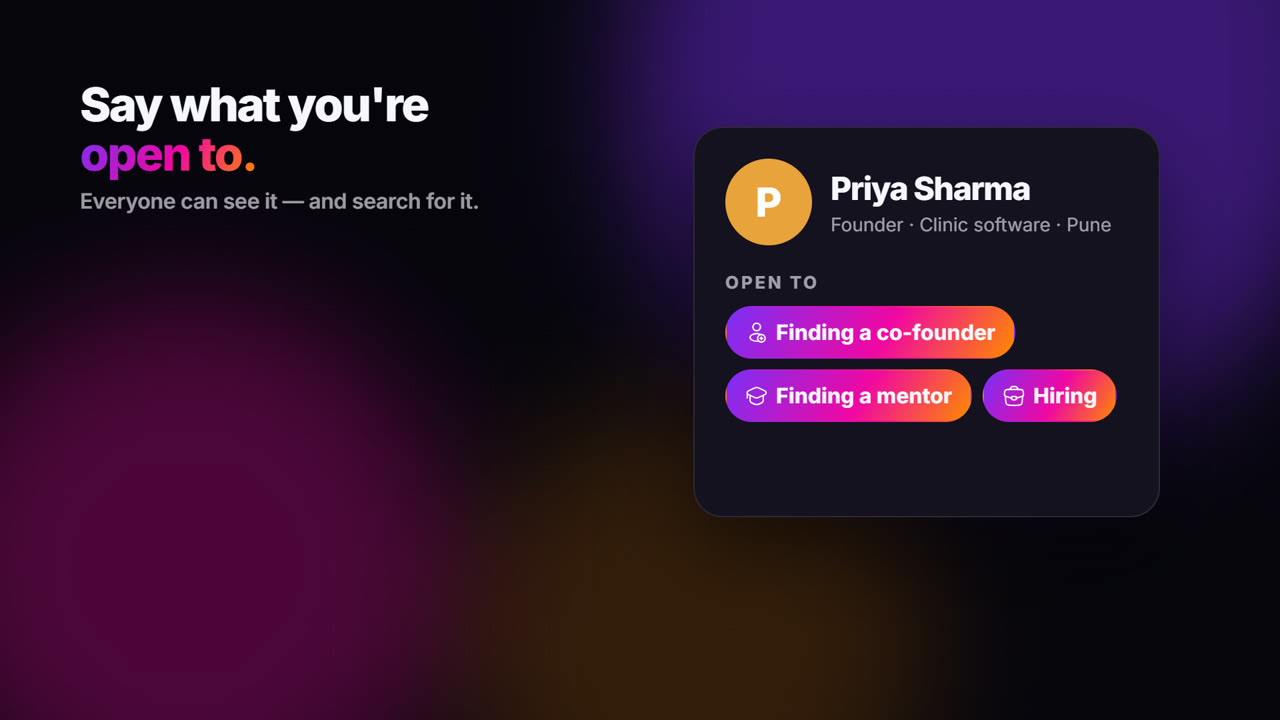
On Networthers, profiles have an "Open to" field: mentoring others, finding a mentor, finding a co-founder, hiring, a new role, investing, raising funds, new clients, partnerships and collaborating. It's the fourth part of your pitch, the ask, turned into a label. It also works as a search filter, so a founder looking for a technical co-founder can find engineers who've said they're open to it, and a designer open to new clients can be found by founders who need one.
Most people never have to say their ask out loud if it's already on their profile.
The connection note (up to 300 characters)
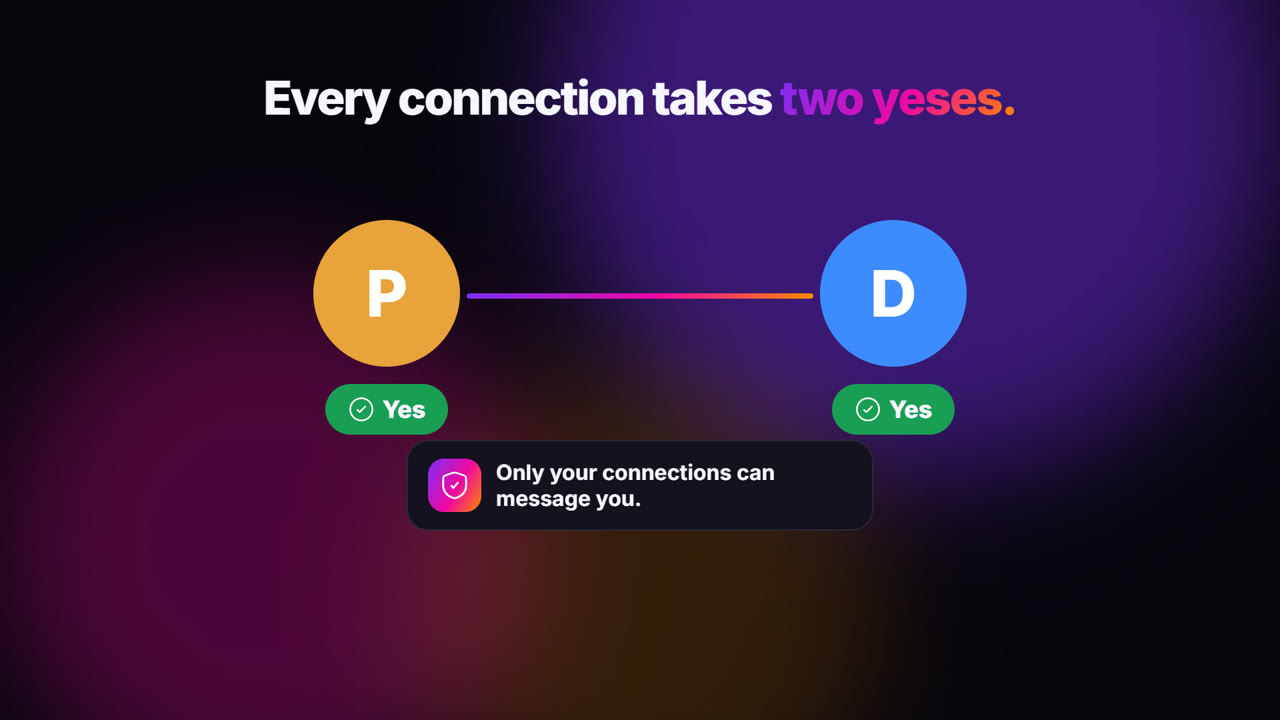
When you send a connection request on Networthers, you can add a note of up to 300 characters. That's roughly a pitch with the proof line removed, plus a reason you're writing to this person. Since only your connections can message you on Networthers, this note is often the first thing someone reads from you, so it matters.
A few sample notes built from the pitches above:
- From pitch 9: "Hi Rohan, I'm Karan. I'm building route planning for small fleet owners, with three pilots lined up. I saw you're open to a co-founder and have built logistics software. Would you be up for a 20-minute call next week?"
- From pitch 1: "Hi Ms Rao, I'm Arjun, a third-year CS student who builds web apps. I saw you lead a product team and are open to mentoring. Could I ask you two questions about getting a first internship?"
- From pitch 11: "Hi Dev, I'm Ishaan, engineering lead at a climate startup. Your React projects caught my eye. We're hiring a frontend engineer to own features end to end. Open to a quick chat?"
Each one is under 300 characters, names a specific reason, and makes a small ask. For more templates for different situations, see how to introduce yourself professionally.
How to test and practise your pitch
Writing a pitch takes ten minutes. Making it sound natural takes a bit longer. These steps help.
Read it aloud and time it
If it runs over 30 seconds, cut. Usually the cut comes from the middle: extra job history or a second proof point.
Try the "repeat it back" test
Say your pitch to a friend, then ask them to tell you what you do and what you want. If they can't repeat both in one sentence each, the pitch isn't clear yet. This is the single most useful test there is, because the real goal is for people to pass you on.
Make two or three versions
Keep a 10-second version (name, role, ask), a 30-second version (the full formula) and a written version for your profile. At a busy event you'll often only get the short one.
Swap the ask for the audience
Your proof line can stay the same while the ask changes. A founder might ask an investor about funding, a developer about co-founding, and a clinic owner about a pilot, all in the same afternoon.
Practise in your own language too
If you network across languages, prepare the pitch in each one rather than translating word for word in the moment. Networthers works in 20 languages and can translate profiles and messages with a tap, which helps with written introductions, but a spoken pitch is better practised in advance.
Common elevator pitch mistakes to avoid
Even strong professionals fall into these. A quick checklist:
- Starting with your job title and stopping there. "I'm a senior associate" tells the listener nothing about what you do.
- Reciting your CV. One proof point is persuasive. Five sound like a list.
- Leaving out the ask. The most common mistake by far. The conversation ends with "nice to meet you" and nothing happens.
- Asking for too much. "Can you invest?" in the first minute rarely works. "Do you invest at this stage, or know people who do?" leaves room for a yes.
- Using jargon. If a smart outsider wouldn't follow it, rewrite it.
- Inventing or inflating numbers. If someone asks a follow-up and you can't back the figure up, you've lost them. Use only what you can show.
- Sounding memorised. Know the structure, not a script. Small variations each time are fine.
- Pitching at people who didn't ask. Ask about them first. Your pitch lands far better as an answer to "what do you do?" than as an opening monologue.
Frequently asked questions
How long should an elevator pitch be? Around 20 to 30 seconds spoken, which is about 60 to 80 words. Keep a 10-second version for crowded rooms and a written version for your online profile.
What are the key parts of an elevator pitch? Who you are, what you do and for whom, one piece of proof, and one clear ask. The ask is the part people most often forget, and it's the part that makes things happen.
Should my elevator pitch be different for each person? The core stays the same, but tailor the ask to the listener. An investor, a potential co-founder and a potential customer each need a different next step from you.
How do I write an elevator pitch with no experience? Lead with what you're studying or learning, add one concrete project (a class assignment, a side project, volunteering), and ask for advice rather than a job. Curiosity and a clear question are enough.
Can I use my elevator pitch online? Yes. Cut it into a short headline, a three- or four-sentence "about" section and a connection note. On Networthers, the ask can also go in the "Open to" field on your profile, where people searching for exactly that can find you.
Conclusion
An elevator pitch is just a clear answer to "what do you do?" with a next step attached. Pick the example closest to your situation, rewrite it with the formula in your own words, test it on a friend, and cut it into a headline, an about section and a 300-character note. Then put it where the right people will see it. On Networthers there's no feed to compete with: just profiles, a clear "open to", and connections that take two yeses. Create a free account and put your pitch to work.
Found this useful? Like it or pass it on.
Meet the people worth knowing
Networthers is professional networking with no feed and no cold messages. Free to join.
Join now