CareersOct 25, 202614 min read
Cold Email for a Job: Templates That Get Replies (and When a Warm Intro Beats Them)
How to write a cold email for a job: subject lines, a five-part structure, templates for recruiters, founders and alumni, follow-up timing and mistakes to avoid.
In this article11
- Why most cold emails for jobs get ignored
- Who to email (and how to find their address)
- Subject lines that get opened
- The five-part structure of a cold email for a job
- Cold email templates for a job (adapt, don't copy)
- When and how to follow up
- Mistakes that sink a cold email for a job
- Cold email vs a warm introduction: when each wins
- A warmer alternative: find people who say they're "open to hiring"
- Frequently asked questions
- Conclusion
A cold email for a job is a short, specific message to someone you don't know (a recruiter, a hiring manager, a founder or an alumnus) asking for one small, easy thing: a quick call, a pointer to the right person, or a look at your application. The ones that get replies are under 150 words, name a real role or problem, show one piece of proof, and end with a question that takes ten seconds to answer.
It does work. Plenty of people get interviews this way, especially at small companies and startups where the person reading the email is the person hiring. But most cold emails are ignored, usually because they're long, generic, or ask for too much too soon.
This guide gives you subject lines, a simple five-part structure, ready-to-adapt templates for different people, a follow-up schedule, and the mistakes that sink most emails. At the end, we'll look honestly at when a warm introduction beats a cold email, and how to get one.
Why most cold emails for jobs get ignored
Before writing anything, it helps to picture the person on the other end. A hiring manager or founder opens their inbox to dozens of messages: internal threads, vendor pitches, newsletters, and a few people asking for jobs. They give each message a few seconds.
In those few seconds, your email loses if:
- It's about you, not them. "I am a passionate, hardworking graduate seeking opportunities" tells them nothing they can act on.
- It has no clear ask. "Please let me know if anything comes up" puts all the work on them.
- It's long. Four paragraphs of background feel like homework.
- It's obviously sent to fifty people. "Dear Sir/Madam" or a wrong company name ends it immediately.
- It asks for a job outright. Nobody can say yes to "please give me a job" in an email. They can say yes to a 15-minute call.
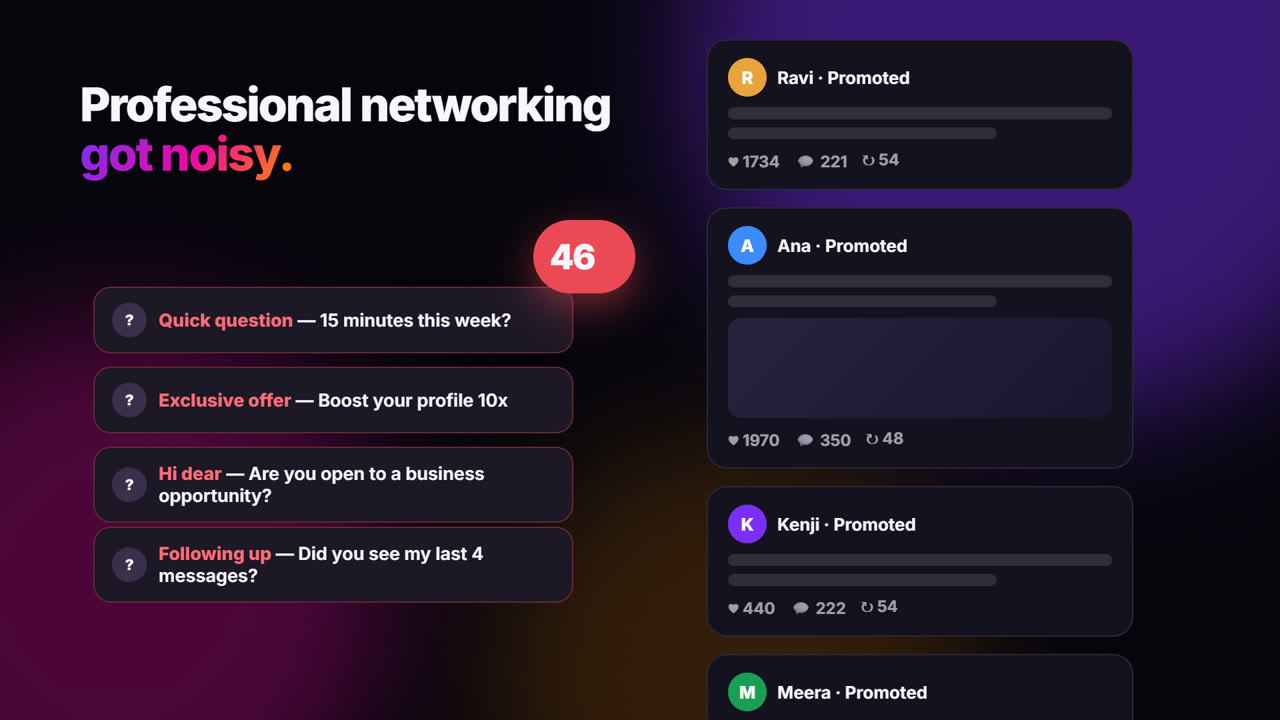
The fix is not a cleverer opening line. It's relevance, brevity and a small ask.
Who to email (and how to find their address)
Picking the right person matters more than the wording. Here's a rough guide:
| Company size | Best person to email | Why |
|---|---|---|
| Under 20 people | A founder | They usually make or heavily shape every hire |
| 20 to 200 people | The hiring manager for the team | They feel the pain of the empty seat |
| 200+ people | A recruiter for that function, plus the hiring manager | Recruiters own the process; managers can push a name forward |
| Any size | An alumnus of your college or ex-employer who works there | Shared history makes a reply far more likely |
To find the person, check the company's website (team or about pages), recent blog posts or talks by people on the team, and the job listing itself, which sometimes names the hiring manager. Professional networks are useful here too.
For the address, many companies use a predictable format such as firstname@company.com or firstname.lastname@company.com. If you can't confirm it, don't guess wildly and send to five variations. A message through a professional network, or a polite note to a general careers address asking to be pointed to the right person, is better than a bounced email.
Subject lines that get opened
The subject line has one job: make the right person think "this is relevant to me". Be specific, be short, and don't be cute.
Subject lines that work:
- Backend Engineer role: 3 years of Go, payments background
- Question about the Product Designer opening
- Fellow IIT Bombay alum, interested in your data team
- Idea for your onboarding flow (and a question about the PM role)
- Referred by Ananya Rao: Marketing Analyst role
Only use the last one if Ananya actually referred you and said you could use her name.
Subject lines to avoid:
- "Job Application" (sounds like a form letter)
- "Opportunity" or "Urgent request" (sounds like spam)
- "Hi" (gives no reason to open)
- Anything in capitals or with exclamation marks
The five-part structure of a cold email for a job
Every good cold email follows roughly the same shape. Keep each part to one or two sentences.
- Who you are, in one line. "I'm a frontend developer with three years at a Bengaluru fintech."
- Why them, specifically. Mention the role, a product launch, a talk, a post on their company blog, or what you have in common. This proves the email isn't a mass send.
- One piece of proof. Not a list of skills. One concrete result: "I rebuilt our checkout page and cut load time by half." Use your own real numbers, or none.
- A small, specific ask. A 15-minute call, the name of the right person, or a look at your application.
- An easy out and a sign-off. "If you're not the right person, a pointer would be really kind." Then your name, a link to your portfolio or profile, and nothing else.
Attach your resume only if the role is open and you're asking them to look at it; otherwise link to it. Some people won't open attachments from strangers, and a link keeps the email light.
Cold email templates for a job (adapt, don't copy)
These templates are starting points. The names and details are made up; replace every bracket with something real and specific to the person. If you can't fill in the "why them" part, you're not ready to send that email yet.
1. To a recruiter about an open role
Subject: [Role title] opening: [your one-line strength]
Hi [Name],
I saw the [role title] opening on [company]'s careers page and wanted to reach out directly. I'm a [your role] with [X years] in [relevant area], most recently at [company], where I [one concrete result].
The role asks for [specific requirement from the listing], which is exactly what I [did / do day to day].
I've applied through the portal. Would you be open to taking a quick look at my application, or letting me know if there's someone on the team I should speak with?
Thanks for your time, [Your name] [Portfolio or profile link]
2. To a hiring manager (no role posted)
Subject: Question about your [team name] team
Hi [Name],
I enjoyed your [talk / blog post / interview] on [topic], especially the part about [specific point]. I'm a [your role] and I've spent the last [X years] working on [related problem].
At [company], I [one concrete result relevant to their team].
I know there may not be an opening right now, but would you be open to a 15-minute call sometime in the next few weeks? I'd love to hear how your team is thinking about [topic], and whether my background could be useful later.
Best, [Your name] [Link]
3. To a startup founder
Founders get many emails, but they also care most about energy and initiative. Show you've used the product.
Subject: Used [product] for a week: one idea, one question
Hi [Name],
I've been using [product] for [use case]. The [feature] is excellent; I did notice [small, genuine observation, kindly put].
I'm a [your role] who has [one concrete result]. I'd love to help [company] with [area you'd work on].
Are you hiring for anything in [area], or would you be open to a short call to see if there's a fit?
[Your name] [Link]
4. To an alumnus
Subject: Fellow [college / ex-employer] alum, question about [company]
Hi [Name],
I found you while looking at [company]; we both studied [course] at [college] (I graduated in [year]). I'm now a [your role] interested in [team or role type] at [company].
Would you have 15 minutes for a call about what the team is like? I'm not asking for a referral, just trying to understand whether I'd be a good fit before I apply.
Thank you, [Your name]
Saying you're not asking for a referral often makes a referral more likely later. People like to help someone who has done their homework. For the full approach, see the guide on how to introduce yourself professionally.
5. For freshers and students
If you don't have work results yet, use a project, an internship, a college society role or something you built.
Subject: Final-year student, built [project] with [tool your team uses]
Hi [Name],
I'm a final-year [degree] student at [college]. I noticed your team uses [tool], so I built [small project] with it: [one line on what it does, plus a link].
I'm looking for a [role or internship] starting [month]. Would you be open to a quick look at the project, or pointing me to whoever handles early-career hiring?
Thanks, [Your name]
When and how to follow up
Silence is normal. Most replies to cold emails come after a follow-up, not the first message, simply because people are busy and emails get buried.
A sensible schedule:
| When | What to send |
|---|---|
| Day 0 | Your original email |
| Day 4 to 6 | A short reply to the same thread: "Bumping this in case it got buried. Happy to keep it to 15 minutes." |
| Day 10 to 14 | One last note with something new: a relevant project, an article, or an update. Then stop. |
Two follow-ups is the limit. After that, move on politely and leave the door open: "No worries if the timing isn't right; I'll keep following what you're building." A third or fourth chase rarely helps and can turn a neutral impression into a bad one.
When someone does reply, answer within a day, make scheduling easy (offer two or three time slots in their time zone), and thank them afterwards whatever the outcome.
Mistakes that sink a cold email for a job
A short checklist before you hit send:
- Wrong name or company. Check twice, especially if you're adapting a previous email.
- Too many attachments. One resume link is plenty.
- A wall of skills. "Python, SQL, Excel, Tableau, communication, teamwork…" Pick the one that matters for this role.
- Asking for a job, not a conversation. Ask for something they can say yes to quickly.
- Flattery without substance. "I'm a huge fan of your company" means nothing without a specific reason.
- Copying the same email to five people at one company on the same day. They talk to each other.
- Typos in the first line. It's the only line some people read.
- Sending from an unprofessional address. Use a plain name-based email.
Also, don't buy email lists or use tools that scrape addresses in bulk. Beyond the poor results, unsolicited bulk email can run against spam and data-protection rules in many countries. One thoughtful email to the right person beats a hundred automated ones.
Cold email vs a warm introduction: when each wins
Cold email is a real tool, not a last resort. It's quick, free, and it lets you reach anyone whose address you can find. It works best when you have a sharp, specific reason to write and the company is small enough that one person can act on it.
But a warm introduction (someone who knows both of you making the connection, or the person already signalling they're open to being contacted) almost always gets a better reception. The reader doesn't have to wonder who you are or why you're writing. We compared the routes in more depth in Networking Events vs Cold Email vs Networthers, so here's just the short version:
- Use cold email when you've found a specific person at a specific company, you have a clear reason, and there's no mutual contact.
- Look for a warm route first when you're exploring a field broadly, you don't know who's actually hiring, or you've already sent cold emails that went nowhere.
The hardest part of job hunting by email is not writing; it's guessing who is open to hearing from you. Most of the people you email never said they were.
A warmer alternative: find people who say they're "open to hiring"
This is the gap Networthers was built for. It's a professional networking platform with no feed and no posts, just profiles of people and what they're open to.
On every profile there's an "open to" section. Members can say they're open to hiring, a new role, mentoring others, finding a co-founder, new clients and more. In Discover, you can search people by role, company or skill, then filter by country, industry and open to: hiring. So instead of guessing which founder might be hiring, you can start with people who have said so themselves.
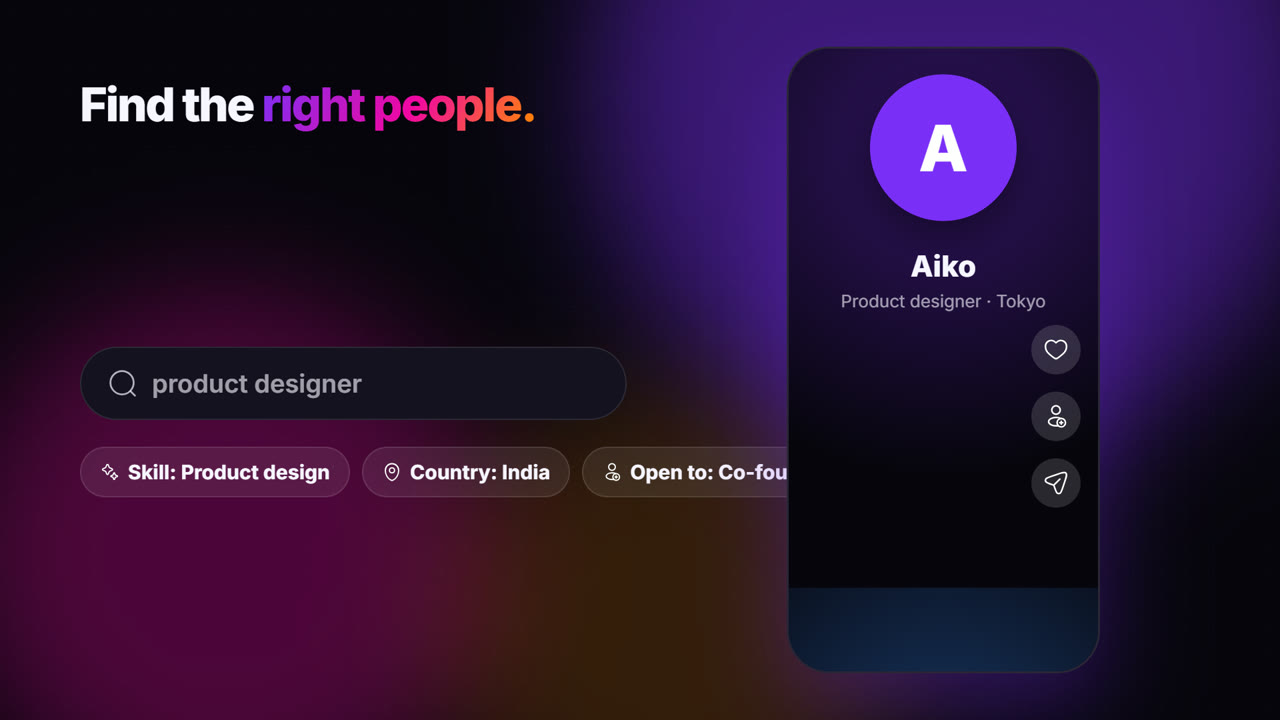
Here's how the job-search side works in practice:
- Set up your profile with a clear headline, your experience and skills, and mark yourself open to a new role. People hiring can find you the same way you find them.
- Search for people open to hiring in your industry and country, or browse with Swipe, which shows profiles one at a time, full screen.
- Send a connection request with a note. You get up to 300 characters, which is the cold email's best line without the rest. Every connection takes two yeses, so nobody is added to anyone's network without accepting.
- Talk once you're connected. Only connections can message each other on Networthers, so there are no cold messages and no paid messages to strangers. Once you're connected, you can share your resume as a document in chat (up to 50 MB, visible only to the two of you), send a voice message, or set up a call.
A connection note for a job might look like this (hypothetical example):
Hi Meera, I saw you're open to hiring for your design team in Pune. I'm a product designer with 3 years in B2B SaaS; I redesigned our onboarding last year. Would love to connect and hear what you're looking for.
That's under 300 characters, specific and easy to accept. You can find more examples in our elevator pitch examples guide. The hire or get hired page has an overview of how this works for both sides.
Being fair about it: Networthers doesn't have job listings or an applicant tracking system, and it's much smaller than LinkedIn, which has extensive job listings and a huge network. If you want to browse thousands of posted roles, a job board or LinkedIn is the better tool. Networthers is useful for the part that comes before or alongside an application: meeting the person.
| Networthers | Cold email | |
|---|---|---|
| Know who's open to hiring | "Open to: hiring" on profiles and in filters | You have to guess |
| Reach anyone, anywhere | Only members, after they accept your request | Anyone whose address you can find |
| Message before they agree | Only connections can message | Yes, which is also why inboxes fill up |
| Share a resume privately | Documents in chat, visible only to the two of you | As an attachment or link |
| Job listings | None | None; you find roles elsewhere |
| Cost | Free account | Free |
The two work well together. Use Networthers to find people who've said they're open to hiring, and cold email for the specific company you've wanted to join for years, where you've found the right person but have no mutual contact.
Frequently asked questions
Is it okay to cold email for a job? Yes. It's a normal, accepted way to reach hiring managers, recruiters and founders, as long as the email is short, specific, polite and sent to one person at a time. Avoid bulk sending.
How long should a cold email for a job be? Aim for 75 to 150 words: one line about you, one about why you're writing to them, one proof point and one small ask. If it needs scrolling on a phone, it's too long.
Should I attach my resume to a cold email? If you're writing about a specific open role and asking them to review it, attach it or link it. If you're asking for a conversation, a link is usually better, because it keeps the email light and some people avoid opening attachments from strangers.
How many times should I follow up? Twice at most: once after four to six days, and once more after about two weeks with something new. Then stop politely.
What's better than a cold email? A warm introduction, or reaching someone who has said they're open to hiring. On Networthers you can filter for people open to hiring and send a connection request with a short note; once they accept, you can message them and share your resume.
Conclusion
A good cold email for a job is short, specific and generous with the reader's time: one line about you, one reason you chose them, one real result and one small ask, followed up twice at most. It works, especially at smaller companies, but it's always a guess about who wants to hear from you. Pair it with a warmer route, where people say up front that they're hiring, and you'll spend less time writing into silence and more time in real conversations. If you'd like to try that, create a free Networthers account, mark yourself open to a new role, and look for people who are open to hiring.
Found this useful? Like it or pass it on.
Meet the people worth knowing
Networthers is professional networking with no feed and no cold messages. Free to join.
Join now