GuidesOct 25, 202613 min read
How to Introduce Yourself Professionally: Templates for Meetings, Events and Messages
How to introduce yourself professionally in meetings, at events, by email and online, with a simple three-part formula and ready-to-use templates.
In this article10
- The three-part formula behind every good introduction
- How to introduce yourself in person at a networking event
- How to introduce yourself in a meeting or at work
- How to introduce yourself on a video call
- How to introduce yourself by email
- How to introduce yourself online: profiles and connection requests
- Mistakes that make introductions forgettable
- Practise until it sounds like you
- Frequently asked questions
- Conclusion
To introduce yourself professionally, say three things in this order: who you are, what you do (in words a stranger understands), and why you're talking to them — what you're looking for or what you can offer. Keep it to two or three sentences, end with a question or a clear next step, and let the other person speak.
That's the whole formula. What changes from situation to situation is the length, the tone and how much of the "why" you lead with. A team meeting needs ten seconds. A networking event needs thirty. A cold email needs a subject line that earns the open. An online connection request needs to fit in a few hundred characters.
This guide gives you the structure, then ready-to-adapt templates for each of those settings, plus the mistakes that make introductions forgettable. Copy them, change the details, and say them out loud a few times before you need them.
The three-part formula behind every good introduction
Almost every strong professional introduction follows the same shape. Learn it once and you can improvise anywhere.
1. Who you are
Your name, and one anchor that helps people place you: your role, your company, your field or how you're connected to the room ("I'm a friend of Meera's", "I'm on the platform team").
Keep it short. People forget long job titles the moment they hear them.
2. What you do, in plain words
This is where most introductions go wrong. "I'm a solutions consultant in the enterprise vertical" tells a stranger nothing. "I help hospitals choose and set up their billing software" does.
A useful test: could a smart 15-year-old repeat it back to you? If not, simplify. Describe the outcome you create or the problem you solve, not the label on your business card.
3. Why you're here
This is the part people skip, and it's the part that makes an introduction useful. Say what you're looking for or what you can help with:
- "I'm looking for my next role in product design."
- "I'm hoping to meet a technical co-founder."
- "I mentor early-career analysts and enjoy it."
- "I'm hiring two backend engineers this quarter."
When you say why you're there, the other person instantly knows how the conversation could help both of you. It turns small talk into a real exchange.
How to introduce yourself in person at a networking event
Events are where introductions feel most awkward, because you're meeting strangers with no context. A short, rehearsed opener removes most of the nerves.
The 20-second version
"Hi, I'm Arjun. I'm a data analyst at a logistics company in Bengaluru — basically, I help them figure out why deliveries run late and how to fix it. I'm here because I want to move into product roles, so I'm trying to meet people who've made that switch. What brings you here?"
Notice what it does: name, a plain-language description of the work, a specific reason, a question back. It's under 60 words.
Templates by situation
If you're looking for a job:
"I'm [name]. I've spent [X years] in [field], most recently [one concrete thing you did]. I'm looking for my next role in [area], ideally at [type of company]. Do you know anyone hiring for that, or is your team growing?"
If you're a founder:
"I'm [name], and I'm building [product] — it helps [who] do [what] without [pain]. We're [stage, e.g. 'testing with our first ten users']. I'm here to meet [what you need: designers, early customers, people who've raised a seed round]."
If you're a freelancer:
"I'm [name], a freelance [skill]. I mostly work with [type of client] on [type of project] — the last one was [short example]. I'm always happy to meet people who [need this / work with people who need this]."
If you're a student:
"I'm [name], studying [subject] at [college], graduating [year]. I'm interested in [field] and I'm trying to understand what the first few years actually look like. How did you get started?"
Body language and delivery
- Make eye contact on your name and on your question — those are the two moments that land.
- Say your name slowly. People hear it once and it's the thing they most want to remember.
- If you have a business card or a profile to share, offer it after the conversation, not before.
- Don't rush. A two-second pause after your "why" gives the other person room to react.
If walking up to strangers still feels hard, our guide on how to network covers how to start conversations and follow up afterwards.
How to introduce yourself in a meeting or at work
Workplace introductions are shorter and more about context: the room needs to know why you're in it.
New team or first day
"Hi everyone, I'm Sana. I've joined as a frontend engineer on the payments team. Before this I spent three years building checkout flows for an e-commerce company, so I'll probably be asking a lot of questions about how payments work here. Looking forward to working with you."
Role, relevant background in one sentence, what you'll be doing, a friendly close. Don't recite your CV.
A meeting with people you haven't met
Go around the table and keep it to one sentence:
"I'm Rohit, I run partnerships, and I'm here because the integration we're discussing will need a partner agreement."
The "I'm here because" clause is the most useful part. It tells everyone what you'll contribute.
A client or external call
"Thanks for making the time. I'm Neha, I'll be your account lead — that means I'm your main point of contact and I'll make sure the project stays on schedule. Before we start, could you tell me what a great outcome from this project looks like for you?"
Clients care less about your title than about what you'll do for them.
How to introduce yourself on a video call
Video calls need a slightly different approach because there's less body language to lean on and people often join a minute late.
- Lead with your name and your reason in the first sentence. People multitask on calls; front-load what matters.
- Turn your camera on for the introduction, even if you turn it off later.
- Put your name and role in your display name ("Kavya Iyer — Product, Acme"), so people can read it while you speak.
- Pause for lag. Wait a beat before assuming no one has a question.
A template for a one-on-one video call you set up:
"Hi [name], thanks for taking the call. Quick context on me: I'm [name], I [what you do]. I reached out because [specific reason — something on their profile, a shared interest, a referral]. I'd love to hear about [topic], and I've got about 20 minutes — does that still work for you?"
Naming the time you've asked for shows you respect theirs.
How to introduce yourself by email
A professional email introduction has to do the same three jobs, but it also has to get opened.
Subject lines that work
Be specific and honest. Some patterns:
- "Introduction from [mutual contact]: [your name], [your role]"
- "Question about your move from [A] to [B]"
- "[Your role] interested in [their project/company]"
Avoid vague subjects like "Hello" or "Quick question", and never pretend to have a relationship that doesn't exist.
Email template: introducing yourself to someone new
Subject: Fellow [field] professional — question about [topic]
Hi [name],
I'm [your name], a [role] at [company/independent] based in [city]. I came across your [talk/article/profile] about [specific thing] and found [specific point] really useful.
I'm currently [what you're working on or looking for], and I'd value your view on [one focused question].
If you have 15 minutes for a call in the next couple of weeks, I'd be grateful. If not, no worries at all — thank you for sharing what you did on [topic].
Best, [Name] [One link: portfolio, profile or website]
Rules for email introductions
- Keep the body under 150 words.
- Ask for one thing, and make it small.
- Show you've done your homework with one specific detail — not five.
- Give them an easy way to say no. People reply more readily when declining isn't awkward.
How to introduce yourself online: profiles and connection requests
Online, your introduction comes in two parts: your profile, which people read when they're deciding whether to talk to you, and your first message or connection note.
Your headline is your introduction in seven words
A good headline combines what you do with who you help or what you're focused on:
- "Backend engineer · payments and fintech · Pune"
- "Freelance brand designer for early-stage startups"
- "Second-time founder building tools for clinics"
- "Final-year CS student · interested in ML and healthcare"
Avoid empty phrases like "passionate professional" or "results-driven leader". They tell the reader nothing they can act on.
Your "about" section: the long-form introduction
Write it like you'd introduce yourself to someone you respect over coffee. Three short paragraphs work well:
- What you do now and for whom.
- One or two things you've done that you're proud of, stated plainly.
- What you're looking for and how people can help or work with you.
Make the "why" visible before you say a word
On Networthers, the third part of the formula — why you're here — is built into the profile. Every member can set what they're open to: mentoring others, finding a mentor, finding a co-founder, hiring, a new role, investing, raising funds, new clients, partnerships or collaborating.
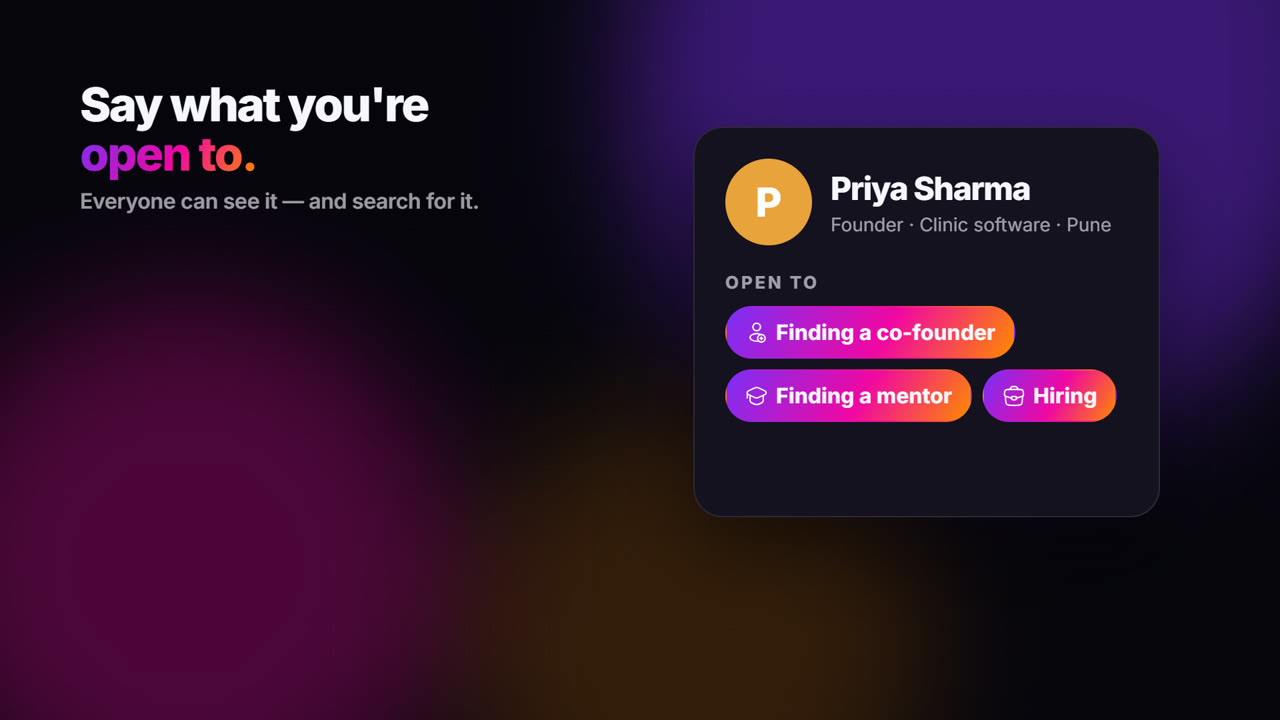
That means someone browsing your profile already knows your reason for networking before you've sent anything. Your introduction can be shorter and more specific, because the context is already there. Others can also find you through it: Discover lets people filter by country, industry and what members are open to — so a founder can search for designers open to finding a co-founder, or a job-seeker can look for people open to hiring.
Connection request notes under 300 characters
On Networthers, a connection takes two yeses: you send a request, and nobody joins your network until they accept. You can add an optional note of up to 300 characters, and since only connections can message each other, that note is your introduction. Make it count.
Here are templates, each under 300 characters:
Looking for a mentor:
"Hi Ananya, I'm a junior UX designer in Chennai. Your move from research into design leadership is the path I'm hoping to take. Would you be open to a short chat about how you made the switch?"
Looking for a co-founder:
"Hi Vikram, I'm building a tool that helps small clinics manage appointments, and I'm looking for a technical co-founder. Saw you're open to co-founding and have built healthcare products. Would love to compare notes."
Job-seeker to someone hiring:
"Hi Fatima, I'm a data analyst with 4 years in logistics and I noticed you're hiring. I'd love to learn more about the team and whether my background fits. Happy to share my resume here once we're connected."
Freelancer to a potential client:
"Hi Daniel, I'm a freelance copywriter who works with SaaS startups on landing pages. Saw you're building in that space. If you ever need help with copy, I'd be glad to share a few samples."
Peer networking:
"Hi Mei, we're both product managers in fintech in Singapore. I'd enjoy swapping notes on how your team handles user research. No agenda beyond that — just like meeting people doing similar work."
What these have in common: a name, one line on who you are, a specific reason tied to their profile, and a low-pressure ask. No flattery, no copy-pasted pitch.
Introducing yourself across languages
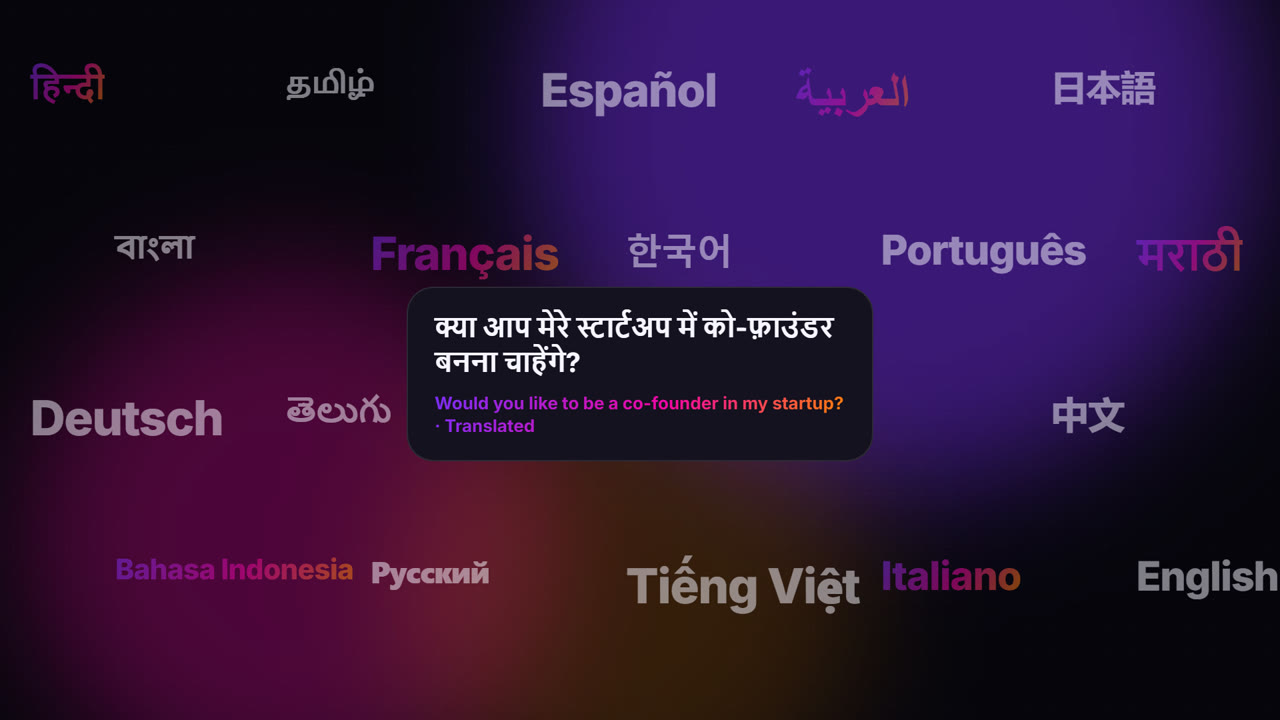
If you're connecting with someone who works in another language, keep sentences short and plain — it reads better and translates better. Networthers is available in 20 languages, and profiles and messages can be translated with a tap, so a note written in Hindi or Spanish can still be read by someone who works in English.
Mistakes that make introductions forgettable
Most weak introductions fail in predictable ways. Check yours against this list.
| Mistake | What it sounds like | Fix |
|---|---|---|
| Starting with your whole history | "So I studied engineering, then I…" | Start with what you do now |
| Jargon | "I drive cross-functional synergies" | Describe the outcome in plain words |
| No reason | Name and title, then silence | Add "I'm here because…" |
| Asking too much too soon | "Can you refer me to your company?" | Ask for a conversation first |
| Talking without pausing | A 2-minute monologue | Stop at 30 seconds and ask a question |
| Generic online notes | "I'd like to add you to my network" | Mention one specific thing about them |
| Underselling | "I'm just a student / just a freelancer" | Drop "just" — say what you do |
One more: don't fake familiarity. "Hey, love your work!" with no detail reads as a template. One genuine, specific sentence beats three generic compliments.
Practise until it sounds like you
A rehearsed introduction shouldn't sound rehearsed. A few ways to get there:
- Write it out, then cut it by a third.
- Say it aloud five times. Change any word you stumble over.
- Record yourself on your phone and listen back once. You'll hear the filler words immediately.
- Make three versions: 10 seconds (meetings), 30 seconds (events), and a 300-character written version (online).
- Adjust the "why" for each room. Your name and what you do stay the same; what you're looking for may change depending on who you're talking to.
Then test it for real. Try your 30-second version on a friend and ask them to repeat back what you do. If they can't, simplify again.
A quick checklist before any introduction
- Is my name clear and said slowly?
- Could a stranger repeat back what I do?
- Have I said why I'm here or what I'm looking for?
- Is it short — under 30 seconds, or under 150 words in writing?
- Do I end with a question or a clear, small ask?
Frequently asked questions
How long should a professional self-introduction be? In person, 10 to 30 seconds — roughly two to four sentences. In an email, under 150 words. In an online connection note, a few short sentences; on Networthers the limit is 300 characters, which is plenty for a name, a reason and a question.
What should I say first when introducing myself? Your name, followed by a simple anchor such as your role or field. Save background and achievements for later in the conversation, when the other person asks.
How do I introduce myself if I'm between jobs or a student? Describe what you do and what you're working towards, not your status. "I'm a backend developer looking for my next role in fintech" is stronger than "I'm unemployed at the moment." Students can lead with what they're studying and what they're curious about.
Should I mention what I want in my introduction? Yes, briefly. Saying what you're looking for — a mentor, a role, clients, a co-founder — is what makes the conversation useful for both sides. Just keep the first ask small: a chat, not a favour.
How do I introduce myself online without sounding spammy? Mention one specific thing about the person's work or profile, say who you are in one line, and ask a simple question. Avoid copy-pasted pitches and never send the same note to dozens of people.
Conclusion
A professional introduction isn't a speech. It's a short, clear answer to three questions the other person is silently asking: who are you, what do you do, and why are we talking? Get those right, keep it brief, end with a question, and you'll find most conversations take care of themselves. Write your three versions today — 10 seconds, 30 seconds and a 300-character note — and you'll never be caught without a good opener again.
If you want a place where your "why" is visible before you say a word, try Networthers. Set what you're open to, find people who match it, and send a short note to start a real conversation — no feed, no cold messages. You can explore how it works for finding a mentor or hiring and getting hired, or compare other options in our guide to networking apps. Create a free account and introduce yourself to the right people.
Found this useful? Like it or pass it on.
Meet the people worth knowing
Networthers is professional networking with no feed and no cold messages. Free to join.
Join now